The last two hours of light.

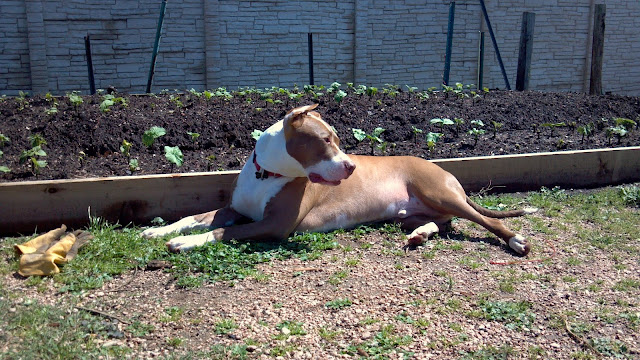
I’ve never so enjoyed two hours of pulling weeds. With our dog on a longer rope to wag his way to greet any wandering garden neighbors, my big floppy new garden hat, and my mud-stained leather gloves, I squatted in the garden and pulled weed after rooted weed and lobbed it at the stone wall. The sprawling kind with the fragile arms. The tall ones with the white pillar flowers. The ones like those, but deep purple. The ivy. The frilly crawling ones. One after another, the hit the wall and fell to the earth. Soon there was a spongy bed of pulled weeds along the wall and a clear patch of earth between the peppers and sweet potatoes where for months there had been a growing bed of foliage.

Now the fish peppers are free to stretch their stripey fruit and variegated leaves toward the sweet potatoes.

And the sweet potatoes, they have a bit of a head start on the reaching-toward-the-peppers…

With the weeds gone, I marched to the tool hut for a shovel and wheelbarrow. Our gardens are supplied with a regular pile of mulch that composts nicely. The hut was sans shovel. It was then that I remembered the hut had been sans shovel for months. That’s ok. I’d learned last time that a wheelbarrow tilted just-so with a hoe to pull the mulch worked as well as I needed.

I tilted the wheelbarrow just-so. I pulled the mulch into it. Tilted it level. Backed it up off the mound and…nada. The wheelbarrow wouldn’t move. Perhaps I was in a hole? Check…nope. No hole. A completely flat tire? Yeah, one of those.

I went looking in the tool hut. There were two new contraptions. They’re like buckets, with tall backs like chairs, that have handles in the back and wheels on the front. Handbarrow? Not sure of the actual name, but it would have to do the trick. It worked surprisingly well! It only held about half of a wheelbarrow’s worth at a time, but was easier on my shoulders than a wheelbarrow. I don’t think it would work outside of a well tended path area, but for a place such as our gardens, it seems kind of perfect.

I hadn’t planned on watering, but with the triple digit heat before this “cool spell” and more heat expected, I figured the last hoorah of tomatoes could use the extra juice.
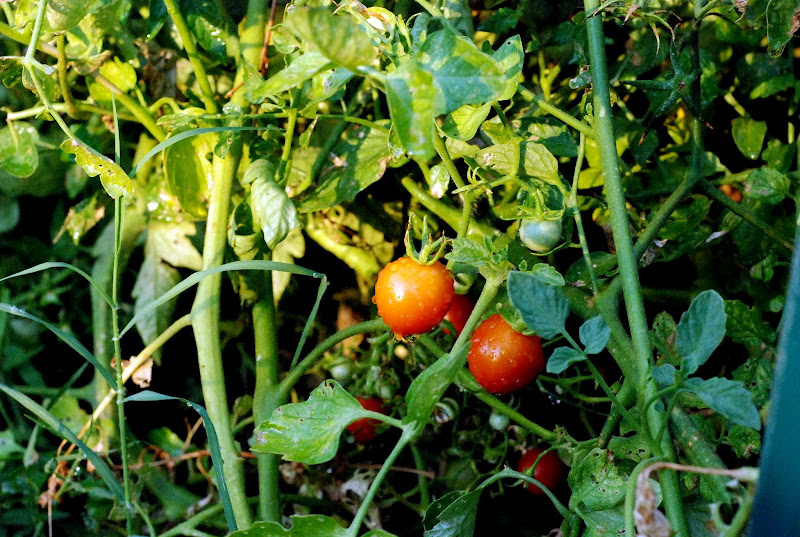
The tomatoes are definitely slowing down on production in this heat. Last year production didn’t make it until July, and this year the later heat and additional rainfall (additional? I mean the fact that there was rainfall at all) has them still going for at least the next week or two.

As much as they’re slowing down in production, they’re still growing. The camera is sitting on the top of a T-post, five feet tall.

They’re getting taller. Last summer my Cherry Chadwick vines were 15 feet long by the time the first frost hit in November. As they get taller, they point out the weaknesses in my trellising plan. These aren’t the tallest vines, they’re just the ones that have yet to fallen over. The others have all fallen over. They don’t fall sideways, because of the twine. They instead fall down the line, between the lengths of twine. This keeps the picking areas as clear as they have been, but it creates such a deeply thick jungle of vines and leaves, that the fruit is hidden from view. A little tomato hide and seek.

I know the Cherry Chadwicks, and the Black Princes will make it through the summer with careful water management and send a second harvest into the world after the heat of the summer has passed. I am excited to see if any other varieties do the same.
Growing like a bean!

At least, that’s what I expect the phrase means.

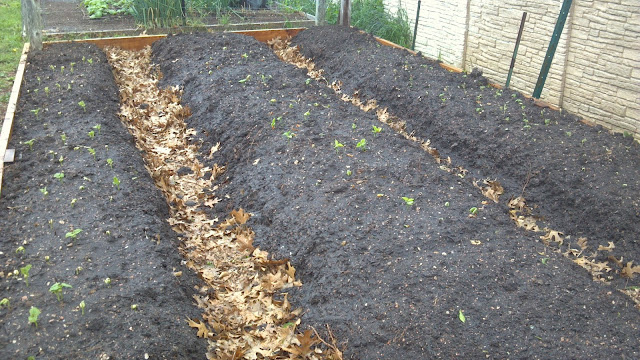
Here’s the Left Bed on March 7th.

A dreary day for us here in Texas. On the left we have Yin Yang beans. In the middle, my trusty Tiger Eye Beans, and in the back (or on the right in the photo) are Soleil green beans.

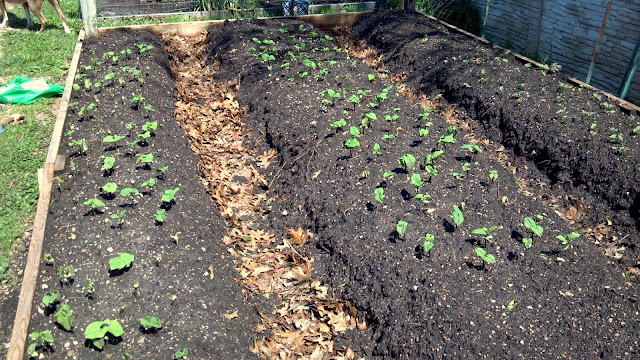
And here we are again, on the 10th.

See those four little legs in the top left? They belong to the Bean Guardian.

He’s doing a stand-up job keeping the birds away.

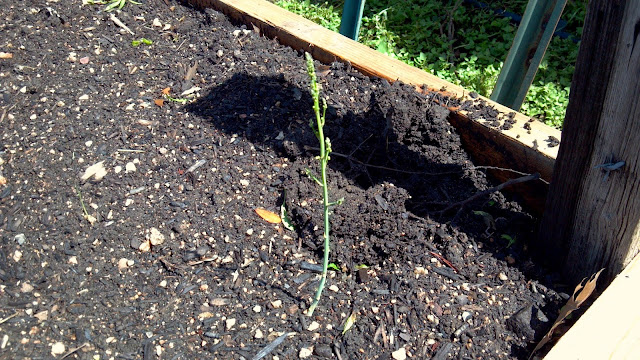
While down there, a new volunteer raised its hand. My best guess is that this tired ol’ bed actually housed an asparagus plant? And that said asparagus plant was the “Hmm, I wonder what this is?” that I saved during the turning under/root-removal process? Any confirmation of asparagus, or ideas of alternatives?

If it is asparagus, it will be my first. I know its a perennial, and that likely its rather upset with me for digging its bed all topsy-turvy. Other than that, I’ll have to read up on asparagus and see how to care for it. Hopefully it doesn’t mind too much the squash I sowed nearby.

Sown on the 11th were my melons and some of my squashes. These varieties are all new to me this year, which is both exciting and leaves me full of trepidation. Will they grow? Will they harvest? Will I like them? We’ll just have to wait and see.

Melons

  • Edisto 47
  • Kansas
  • Tigger
Inter-planted with Sunflowers!
Squash (so far)
  • Early Golden Crookneck
  • Lemon
  • Kamo Kamo

Also, I did a simple soil test kit (I buy the little ones for $4 that do pH, Nitrogen, Potassium, and Potash) on the Right Bed. As expected, the pH is high. So far each soil test I’ve done in a new area has been in the “dark green” or “8+” range. Thankfully, I have some sulfur on hand to mix in. Surprisingly (and thankfully) the Potassium and Potash are both at reasonable levels! This is a first, since usually when I build a garden bed I’m starting with undernourished turf-just-removed soil. The Nitrogen is low, but that’s easily fixed with some Blood Meal.

Planned for the left bed are two more squash varieties, the tomatoes, the peppers, and if they ever arrive in the mail – the sweet potatoes and strawberries.


(Thanks to DH for the pictures! We walked to the gardens this time, and in remembering my Hori Hori, seeds, graph paper plans, and gloves, I forgot a camera. Hooray for phones!)

Digging in the dirt!

Digging in the dirt doesn’t make for the most exciting of posts, or the prettiest of pictures.

I spent a few hours in our afternoon sunshine working on the Right Bed.

I started the initial double-digging of this fallow bed today. The intense web of grass roots made this slow going.

Slide the spade into the earth.

Pry.

Turn.

Squat.

Sift.

Pick.

Bucket.

Repeat.

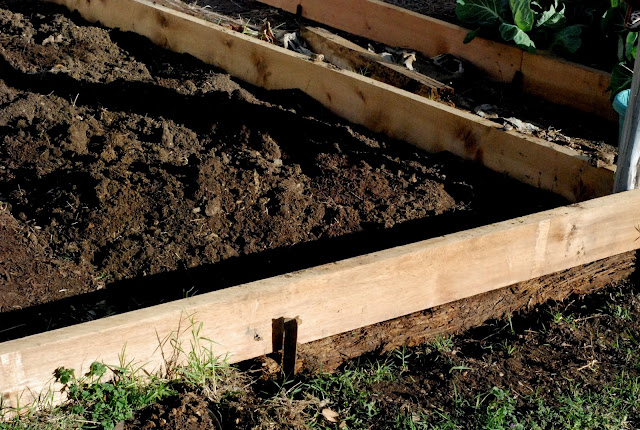
Thankfully, the soil in this bed feels lively! It’s loose, crumbly, a little sandy, and full of some healthy earthworms! I haven’t met soil like this before in Texas. It’s exciting to not have to start from scratch with the cloying, airless clay that is all so common in this area. During my digging, I unearthed an old 4″x4″. Pocked and soft with decay, I thought to give it one more task before the earth reclaimed it. The builders of the garden beds used some really nice cedar planks around the edges of the beds. Unfortunately, they left them floating just above the surface. This means that no matter how diligently I remove weed roots now, or weed later, the weeds will wriggle right under the walls and invade the garden. In an attempt to block (or at least dissuade) their wiley ways, I nestled the found board under the edging plank (you can just see it in the picture above.) Hopefully that works at least until next year.

So, what else is going on in this lovely weather?

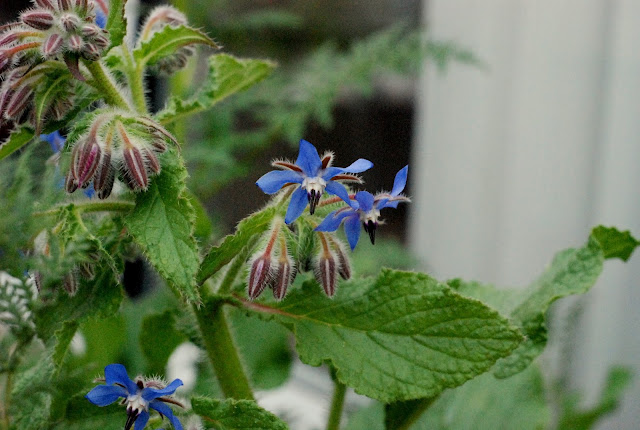
The Borage has blossomed! If you’ve never grown Borage, I find it pretty, but it’s also pokey, and tends to spread, so be careful. Borage flowers taste a little like cucumber and can add a dollop of periwinkle to your salad, or I hear you can even make a medicinal tea.

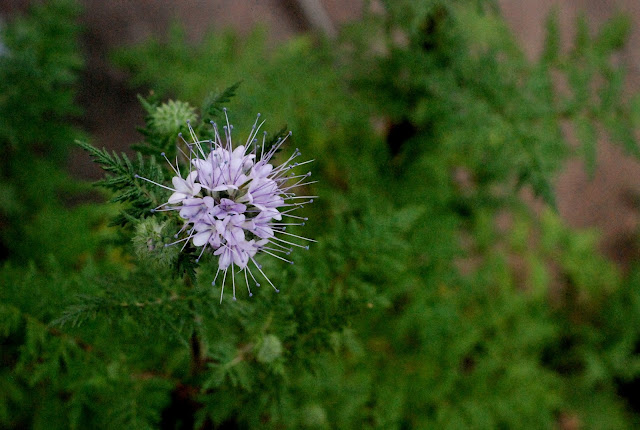
My volunteer fern is also throwing out some food for the bees.

Isn’t that delicate and lovely? Last year was my first fern attempt (Ferns, in Texas? Yep. I’m a rebel.) I sowed them about this time last year, and not many of them came up. Then, early November, with the rain came the flower sprouts. I rather like having a little experimental bed for the flowers to reseed and see what does what. I’m doing just that with the little strip of earth in the back yard between the sidewalk to the patio and the back door. The builders thought to leave 12″ of green space between the foundation and the sidewalk. It’s also only about 4″-8″ deep, depending on where you dig.

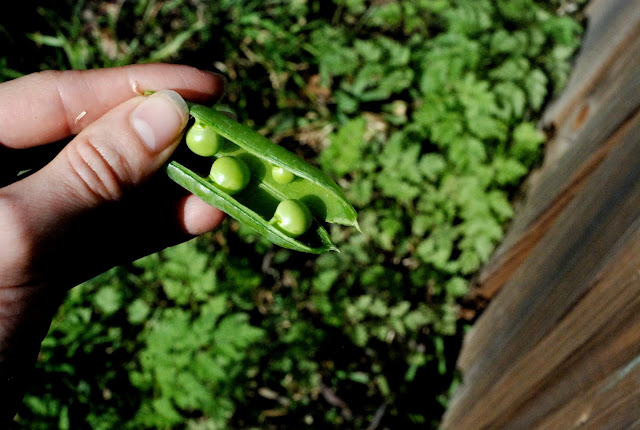
There are many fun things (for me) about gardening, and one of them is to push myself to try new foods – or to have them available to me for the first time. Most recently, I’d only had peas in their frozen or canned form. I managed to right that wrong just yesterday. My first garden peas! (First for me as a gardener, and for eating.)

I thought they tasted great – like if peas and freshly cut grass popped in your mouth. These were simply labeled “English Peas” on their seed packet.

The weather outside is weather…

It was 88 degrees on Thursday. Today was a high of 63. It’s supposed to be 40 tonight.

Seasonal changes where I grew up in the Pacific Northwest of the United States were gradual. Days slowly got drier and warmer as they got longer in the spring. In the fall, they slowly lost daylight hours to night hours as the temperatures mosied down the thermometer until winter. Texas is different. Central Texas is a fan of a 40 degree temperature drop in a matter of hours. A cold front comes in and that’s that. The humidity is pushed out, the sky clears, and the temperatures plummet.

Thursday, I took my tomato and pepper sprouts outside for the first time and worked in shorts and a tank top and was warm. Today, I was in jeans and a tanktop while shoveling a cubic yard with DH. Tonight, I’ll be bundled in pants, long sleeves, a jacket, hat, scarf, and gloves. Oh, how the winds change things.

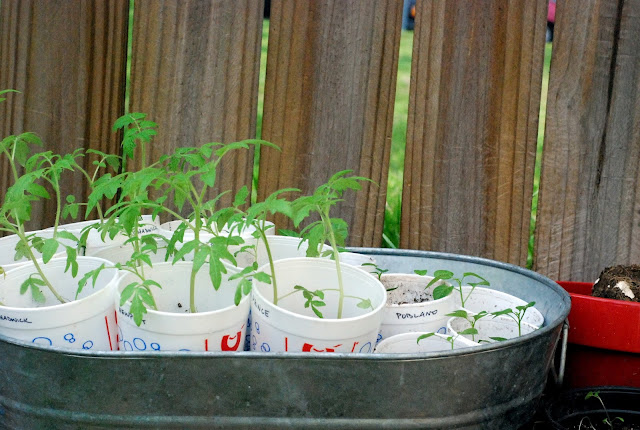
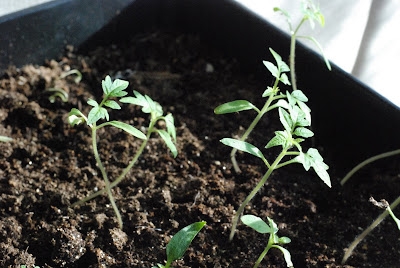
Each year so far I’ve forgotten how the peppers stay small for so much longer than the tomatoes do. These tomatoes were the usual little leggy sprouts in a tray, that got planted up to their necks about a month ago. Here they are, ready to be buried once again.

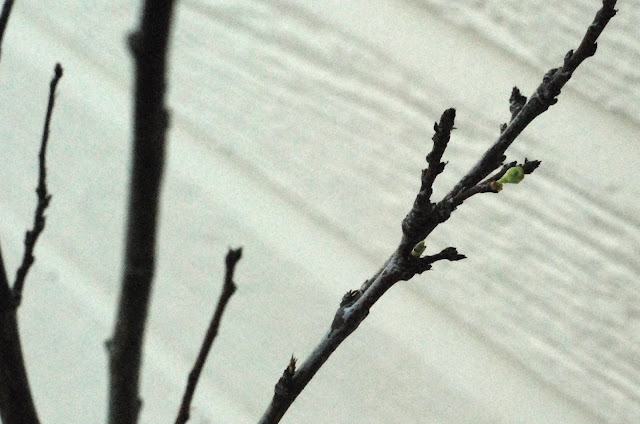
What else is the weather doing? It’s bringing things to life. This is June. (We name things in our household. Not all things, but more things than I think most households name.) June is a grafted plum tree. She houses four varieties on her delicate limbs. She came from Raintree Nursery late last spring.

June thinks it’s time to bud, and it very well may be.

Speaking of things that it’s time for…

Each year for the last few years DH and I have gone camping for our anniversary. It gives us a chance to be out in the quiet wild of the world, spend time with each other away from the laundry (but not the dishes), away from the world of now-now-now, away from cell phones, laptops, work, and people, and just be. We had planned to go this weekend, and oddly both of us, as we were set to start packing the car, looked at one another.

I didn’t really want to go. He spoke up. “Do you really want to go? You don’t seem that excited.” I wasn’t. It turns out he wasn’t either. So instead we’re doing some homesteading/nesting for our anniversary weekend. Part of that is putting in some serious labor on the new garden plots.

Yesterday, DH spent a couple of hours turning the rest of the Left Bed to aerate the beaten down, lifeless soil. I followed behind on a beam of wood that distributed my weight evenly so as to not re-compress the soil, pulling out bucketful after bucketful of weeds. We even found a potato and a beet the previous gardener had left behind! For some reason, our dog, T, thought that potato was the most fun that could be had at that moment and spent the next twenty minutes tossing it into the air to himself, chasing it down, and tossing it again.

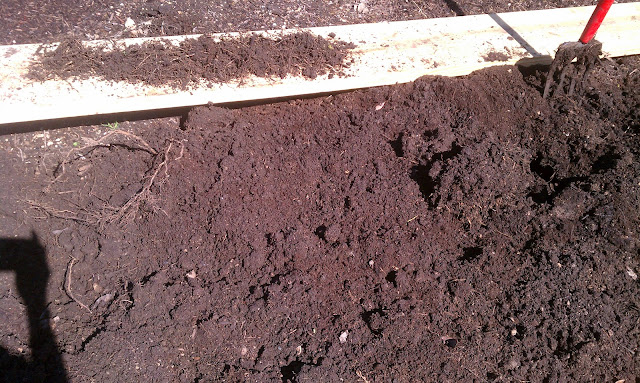
Today, DH drove us in his little truck to Whittlesey’s for a cubic yard of soil. We ended up getting their Austin Soil Amendment. 66% organic compost, sand, and other nutrients to help feed the earth and break apart our dense clay. The mix sparkles ever so slightly in the sunlight. We spent the afternoon with two shovels, a wheelbarrow, and a lot of back muscles. With a little final work with a hoe and a rake, the mix was spread evenly across the 200 square feet.

Tomorrow will be a trip to the lumber yard for enough 2″x6″ beams to make two foot-wide paths twenty feet long. When those are in place, I’ll turn the amendment into the soil, sow a couple hundred drying beans, water, and move on.

Move on? Well, yes. There’s a-whole-nother 200 square feet that needs to be weeded, turned, amended, and structured.  That bed needs to be finished next weekend so the tomato and pepper plants can settle into it before the heat really comes to stay for good.

Saturday, it rained.

2011 marked the worst drought on record, by more than double the 2nd worst drought on record.

As such, I will not complain about rain. No matter the amount, the frequency, the clouds, or the cold. We need it. I’m grateful for it. I can almost hear the trees sigh in pleasure from it.

It did, however, put a damper on my Saturday plans. I had planned to spend most of the day on Saturday out in my new community garden plots. Turning the earth. Aerating. Amending with manure. Enjoying the air. Acquainting myself with the soil. Instead, I spent the morning at breakfast with DH and his mother before trekking to the Farmer’s Market  to pick up some more red carrots, beets, kale, and mushrooms, among other goodies.

Upon arriving home, I promptly fell asleep for an impromptu nap. Awoken just in time for some dinner before a movie date, and that was the day.

Sunday, however! Sunday broke to clear skies, warming air, and a soft and cheerful breeze. I downed my breakfast of market finds sauteed in bacon grease (complete with duck egg, a first for me!) and started loading.

I still had maybe a 1/3 of a cubic yard of farm manure left over, and began shoveling it into the wheelbarrow, wheeling it to the truck, up a ramp, and dumping it onto some weed cloth. When most of it was in the truck, I loaded up my tools, my water bottle, and my gloves, and took a short drive to the gardens.

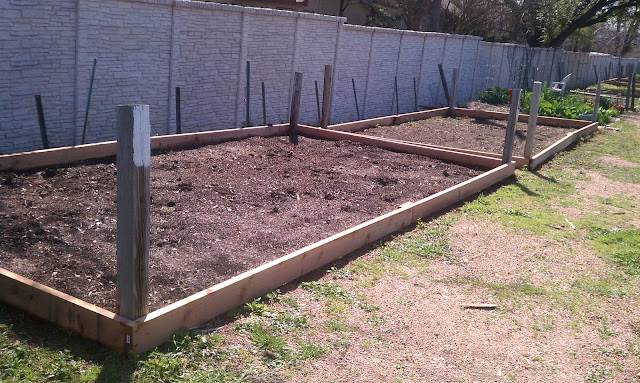
Those, dear readers, are my two new garden plots. 10’x20′ each. On days where I don’t need to haul manure, I can walk to these gardens from my home. They’ve allowed me to quintuple (quintuple!) my garden space for 2012! I can’t stop smiling when I think about what that means.

The one in the foreground had a gardener last year. According to the gardener of the neighboring plot (not pictured) my predecessor was a bit angry of a lady. The soil appears to have taken the brunt of her anger. It is compacted. It is lifeless (I found one little earthworm, a mere two inches long, in 30 sq ft of digging.) And while the bed may look mostly cleared out in the photo, do not be fooled. (I was fooled.) It is not a weed-free bed. It is a weed-full bed…covered in mulch.

The bed in the background, according to the same neighboring gardener, was weeds all last year. I was worried when I heard this. However, upon first touch, the soil is lovely. It’s loose, crumbly, and soft. That has never happened for me in a new-to-me garden bed in Texas.

With those as my starts, I started in on the harder undertaking. It was time to show the soil in the foreground some love. It was time to see if I couldn’t breathe some life back into it. And with that in mind, I got to work.

Apologies for the phone-photo-quality.

I believe these are tomato roots? I can’t say for certain. Since I can’t say for certain, they must come out. Nevermind that it will take me six times as long to do. People usually don’t believe me when I tell them I only weed my gardens a couple times a year. This is the work that must be done to get to that stage. My dad used to say that things worth doing are worth doing well. If it’s not worth doing well, it’s not worth doing.

The more work I do now, the less I’ll have to do in the future. The future is a lot longer than the now.

And so, after three hours of re-shoveling manure into a wheelbarrow, down the ramp, and into the beds, followed by 30 sq ft of earth turning, root sifting, and deep root pulling, I was hungry and it was time to head home.

I’ll make it out again tomorrow evening (tonight is Mini Tri Training) and hopefully again Friday morning. This weekend we go camping for our anniversary, so Saturday will once again be full of other things (like campfires and swimming!) Sunday, however, should have a few more solid hours of root-pulling in store.

I think tomorrow evening, I’ll be planting beans in my home-plot. Three weeks early, yes, but with a high of 81 on Thursday and the lowest night temperatures only hitting 42 for the next ten days…I’m feeling like taking a risk.


The outside world.

The weather today was absolutely lovely! I couldn’t wait to get out into the air, the sun, and the earth.

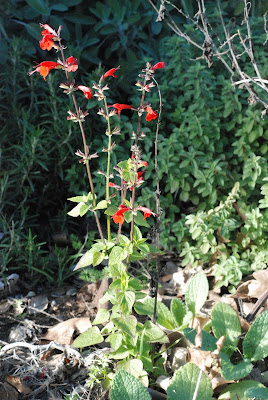
This little guy is doing his part to keep the bees fed in January. This is a self-sown Texas Hummingbird Sage. Last spring was my fourth attempt at growing Texas Hummingbird Sage from seed. (Trial & Error often requires multiple trials!) I managed to get four little seedlings to put out two sets of “real” leaves. I put two in the front bed, and two in the rear bed. The rear bed ones didn’t make a week, baking in the sun if I missed their morning water. The front bed was a little kinder, and both sprouts made it about four inches high. I couldn’t figure out why one died, but I suspect a bird or other creature thought it would make a tasty salad. That fourth stubborn sprout ended up surviving all summer long and into the fall before the first freeze took it. It topped out about 18″ tall and had bees on it every day! This little guy shown above is an offshoot from the base of the old plant.

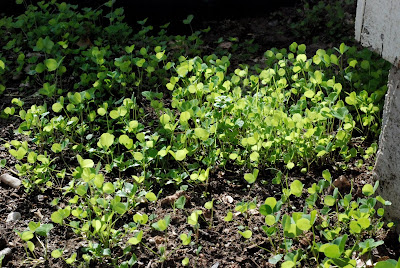
Growing up in the Pacific Northwest, one of my all-time favorite seasons was a short one. In the Willamette Valley (and I’m sure elsewhere) farmers plant a cover crop of red clover. In May, the fields are abloom. Mile after mile, acre after acre, are afire with crimson blossoms on rich green stalks. They only last a week or three, but are one of the things I miss most about that corner of the world. This clover-looking mess is actually my own little patch of Crimson Clover. It’s my first year with it (second planting attempt, the first one died off due to inattention (oops!)) and I’m hoping to get a bloom or two. It’s a new bed that previously only held Horse Herb (a weed, in my estimation) and a Hackberry. I amended it a bit with manure, blood meal, and bone meal. We’ll see how it goes. I’m glad to see them hanging in there, as that is also where a lot of water from our gutter-less roof runs off.

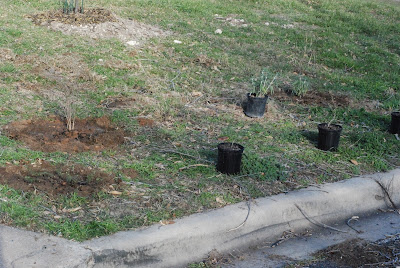
And finally, the front of the lawn. I decided a few months back that I wanted to absorb some of the scraggly lawn into a native bed for the bees and butterflies. My parents were kind and generous enough to send me some of my Wish List Plants for Christmas in order to get it started!

In the top left corner, you can see the dirt dam and mulch of the new Mexican White Oak. Down the left edge, you next come to a brown circle with a few sticks visible – that’s a Fragrant Mimosa. Unbeknownst to me, but quickly discovered by my other half – it has thorns. Be mindful if you choose one of where you plant it! Continuing down the lefthand side of the photo is another brown circle, this one contains a Prairie Verbena! Moving along the curb we have a few Black Daleas still in their pots, and behind them, one in one out, are two specimens of Mexican Bush Sage.

All of these plants my folks were able to order online from a local business (bonus points!) They’re called Landscape Mafia, and not only do they have a nice variety of natives, for very reasonable prices – they deliver! My parents live far away and ordered shipping. The folks at Landscape Mafia had the care for their plants, and the presence of mind, to realize that I lived a short drive away and some nice man from their staff delivered them directly to my front porch! Color me impressed.

Since these are natives, who all claim to not want super-rich soil, I worked a little manure into the soil of each spot, watered deeply, and that’s it for now. Tomorrow I’ll put the others in the ground and see how I feel. The ultimate goal for this spot? No grass, these big “anchor” natives, and a sprinkling of Black Foot Daisies, Henry Duelberg Sage, and maybe because they make me so very happy that I surely need more:

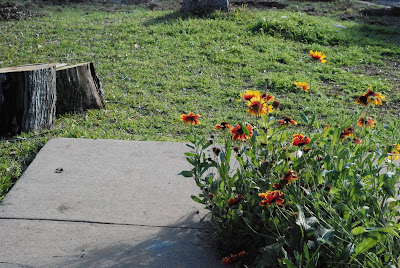
Blanketflowers!


Transplanting

I did some transplanting today!

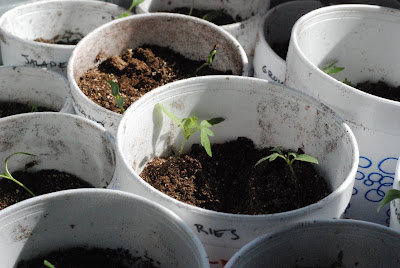
It was time for the tomatoes and peppers to give up their stake in the seed tray for more root room.

Something I’ve forgotten to do before is keep track of varieties after I transplant. I did well enough this year documenting where I planted what in the seed tray. Now to attempt to do well enough tracking the varieties into their new cups.

Things you can use for transplant pots:

  • Cups! I dislike that our recycle service will take #6 plastic, but not #6 styrofoam. This year, I saved up our Sonic cups with the intention of driving them to Ecology Action. Lucky me that I kept forgetting and now had plenty of cups!
  • Bottles. Water bottles, soda bottles, other plastic bottles. Simply cut off the tops, poke holes in the bottom, and voila!
  • Actual pots. I save the little plastic nursery pots that plants come home in sometimes. Occasionally they break, and then they go in the recycle, but otherwise they’re saved and reused.
  • What else do you use for seedlings when you don’t have pots?

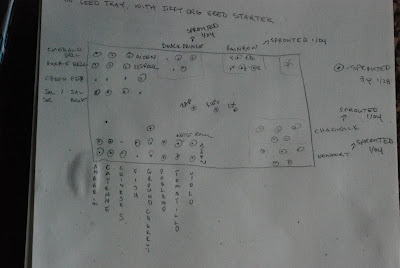
So, how to track the varieties through the move? Well, we need to start with the schematic of the seed tray:

Whatever little shorthand codes you come up with to suit your process is fine. I put a dot for each seed planted, and circle the dot if that seed sprouted. This helps me keep track of which seed varieties have a good germination rate. I use that info to either assess my seed-saving techniques to improve, or take my seed-buying-dollars to the best performing seed-saving companies. Interestingly, my Cherry Chadwick, “Newport” purple heirloom, and “Rainbow” tomatoes all had 100% germination rate from saved seeds. The “Rainbow” seedlings didn’t last. I’m trying them again in a new seed tray, one color per row (purple, red, orange, and yellow.) My saved Czechoslovakian Black Pepper Seeds? 25%. Trying those again as well.

Cherry Chadwick as the main stars, “Newport” in the foreground, pre-transplant.

So I took my Sonic cups, counted up my seedlings, and began labeling each cup. I took over the shoe bucket in our foyer, filled it with the cups, and headed outside. Each cup was filled by thirds. The bottom third of each cup I filled with regular clay soil from the yard, the middle third I filled with manure, and the top third received a fresh topping of seed starter. Then, cup by cup, I looked at what was labeled on the side, and matched the seedling in the tray to the label on the cup.

A serendipitous factor of using Sonic cups? You can write on the side!

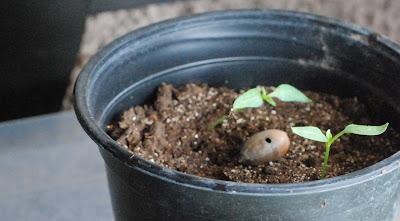
But how do you label things that you can’t write on easily?

These peppers get an acorn label. I used three other pots just like this with labels of red rock, a white pumice stone, and the cap of this acorn. If you scroll back up, you can see that noted on my schematic. As adorable as I find the row labels, especially the metal ones, I find it a fun (and free!) challenge to find other ways to label pots.

So that’s it? All the seedlings are transplanted?

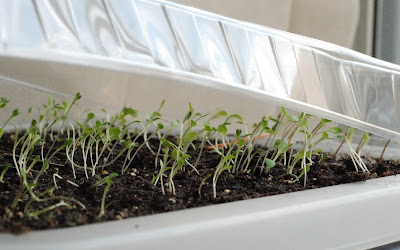
Well, no. I have a bunch of little lettuces, some marigolds, basil, cumin, and lemon balm. They’re hanging out in a too-shallow (Trial & Error will result in errors!) tray awaiting their turn. Now, to decide where to put them before they strangle one another…


Well, hello there!

It’s been a little while, eh?

Apologies for that. Lengthy work hours eat up the few hours of daylight this time of year. I cannot imagine managing with the even shorter days farther north.

Lack of daylight leads to lack of photos.

There hasn’t been a lack of life sprouting up and work to be done, though.

I’m still catching up on the picture-taking, but did manage a few shots when the sun was still up.

Roodnerf Brussels Sprout.

Of course, one must work in soil supplements most times. For powders, I like using a rake.

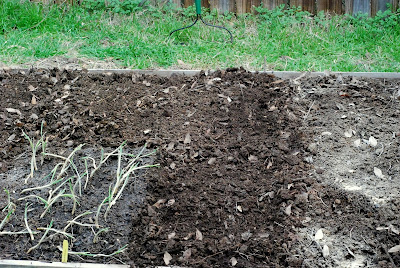
This is my first time using rock phosphate. I’m hoping it helps. My soil tends toward too much nitrogen (user error through trial and error) and alkaline pH. I haven’t found a supplement that added enough of the others to get my little $3 Burpee Soil Test Kit even into the mid-range. Fingers crossed that this does that trick. I picked it up for a reasonable price at The Natural Gardener.

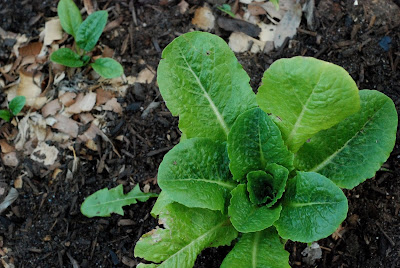
A volunteer romaine from the lawn that I brought into the fold, with some seed sown Bloomsdale Spinach in the background.

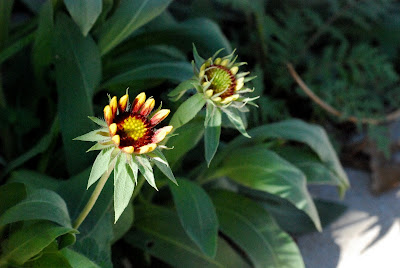
The Blanket Flowers in the rear side patch have been trying with all their might to push a bloom (or two!) to the tops of their stalks. They have succeeded.

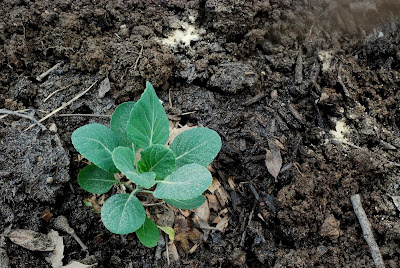
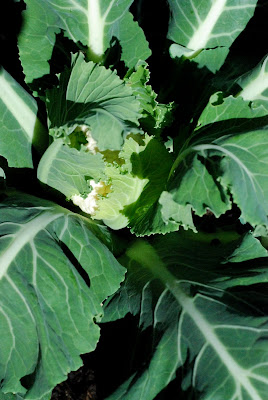
And finally, I’ll leave you with a peak at a secret! I cannot wait for it to enlarge into something for dinner!

This one’s called Amazing Cauliflower.