It’s dark out.

I find myself with enough energy and time in the evenings to put in some good garden time, but by this time it’s already dark out. DH is studying, and if I don’t find something else to do, I’ll end up logging some more hours with work.

So tonight, I think I’ll do a little history.

Once upon a time, there was a girl in an apartment. The apartment had a little balcony, maybe 5’x10′, that was south-facing. It was a second floor balcony, with an upstairs neighbor of the bamboo mat/wind chime variety, and a downstairs neighbor that rotated through from friendly drug dealer that kept to himself, to unfortunate alcoholic couple that started out loving us and ended up leaving us with a few sad stories, to a couple of newly weds who fought a fair bit (although less often and less vocally than the previous neighbors.)

Below the balcony was a small plot of land that used to house some grass and a tree. The grass had long since been shaded into packed dirt, and the tree left only a stump for some interesting fungus to feed upon. Across the strip of bare earth was a fence, and behind the fence – wilderness. Well, as wild of a wilderness as you can find in a suburb. Enough wilderness to get birds in the trees, squirrels digging around for acorns, and the occasional raccoon. Our first spring there revealed a lovely surprise – blub, burgle, bubble, gush.

There was a waterfall through the trees, just outside our bedroom window! When it rained, the water would rush over the small fall and make the most beautiful serenade to the spring days. We could walk out of our building, through the fence, and be at the waterfall in less than a minute. Sometimes you could even hear children laughing as they made their way to the pool at the bottom to wade.

This unexpected gift gave the girl a longing for nature like she hadn’t known in years. She and her DH would wander down the creek path and take pictures, hold hands, and talk of the future. The future that would hopefully include a home-home, as they called it, on land, with a large kitchen garden and an orchard surrounded by a low-slung stone wall with a gate.

Over the years, she’d carted along on her many moves a few green things. There was the cactus, Napoleon. There was Heidi, the Hydrangea, too.
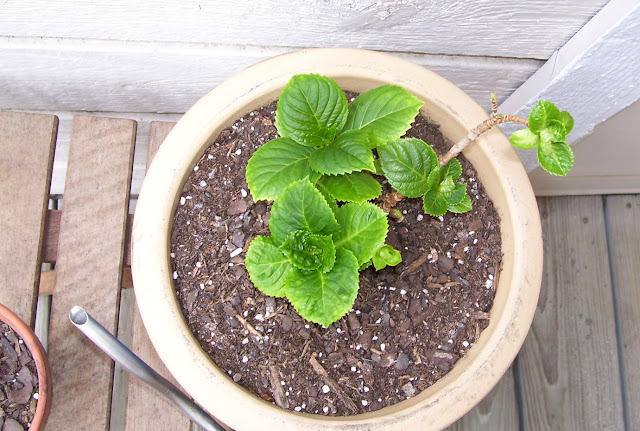
Heidi had been in the “family” for nearly five years at this point. Never having blossomed, she earned her keep on hope alone.

She tried her hand at some edible plants for the first time as well. Rarely one to take the easy route as first choice, she started with seeds.

Tomatoes!
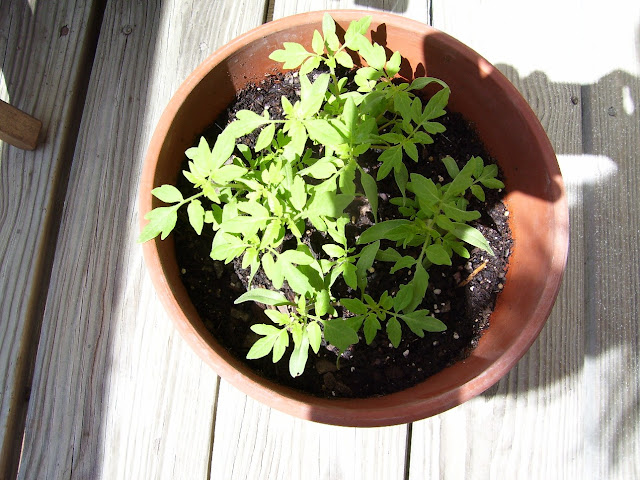
Who were split and transplanted into a strawberry pot…
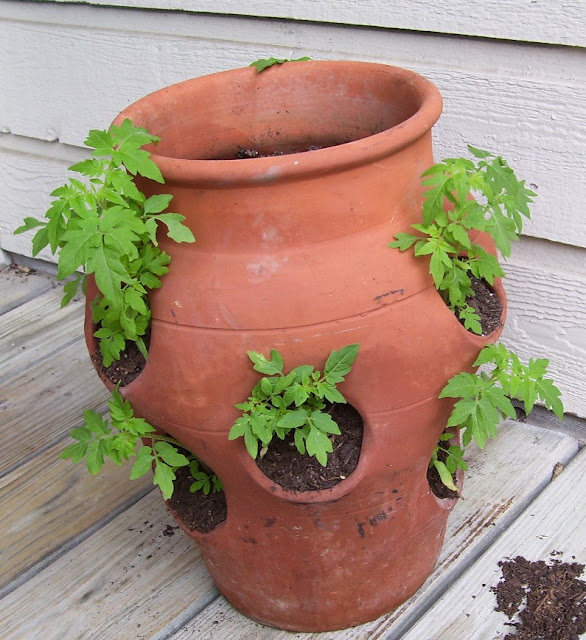
Where they HATED it…and so were moved again larger pots…
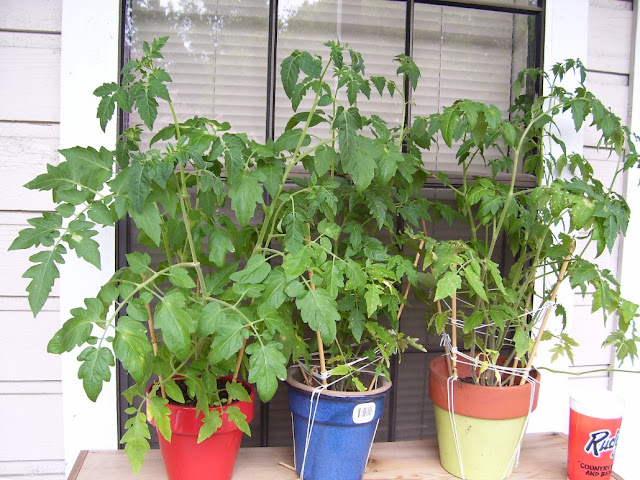
Where they got a little busy with the bees…
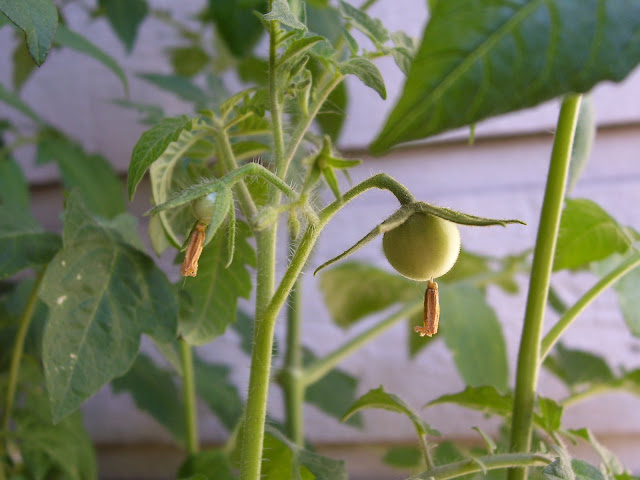
And then the sun worked its magic…
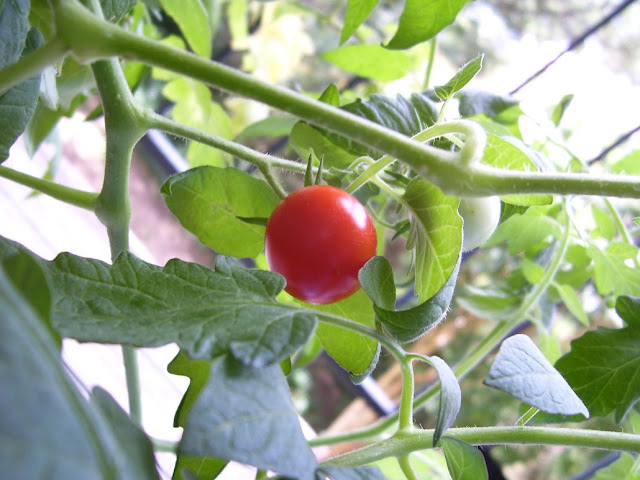
And that, dear readers, is the story of DH’s first balcony tomato! And just part of the beginning of the story that has gotten us here. This is also my first experience with Cherry Chadwick tomatoes. Just wait to read about what these tomatoes ended up accomplishing in their short lives.

Oh, and all I could find so far for a picture of Napoleon, has him in the bottom of this frame, poking up.
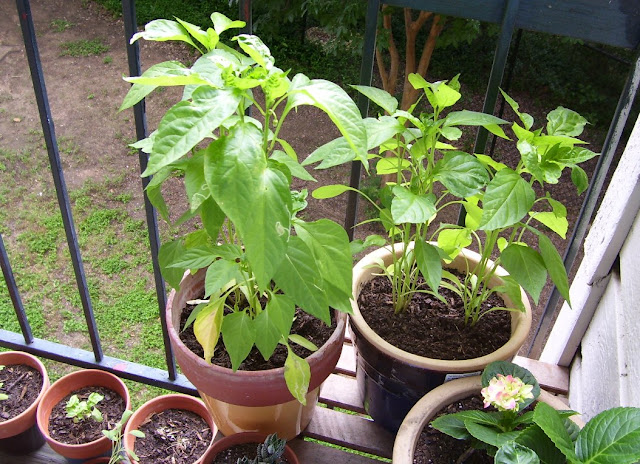
You can also see, on the right, that Heidi finally bloomed! She left the world after that bloom, but it got rather pink and lovely before she went.

Things I learned in those days: 

  • I honestly don’t know what would like to grow in a Strawberry Pot. The tomatoes hated it. Herbs hated it. Maybe strawberries would actually like it? Although I doubt it for how much water they seem to want.
  • Peat pots, are not my favorite. The roots struggle to bust out, and no matter what the label said, I never witnessed the netting composting naturally in the transplanted pot.
  • Balconies never yielded enough food to replace any store shopping, but there still isn’t any comparison to be made between a tomato still ripe from the sun.
Digging in the dirt!

Digging in the dirt doesn’t make for the most exciting of posts, or the prettiest of pictures.

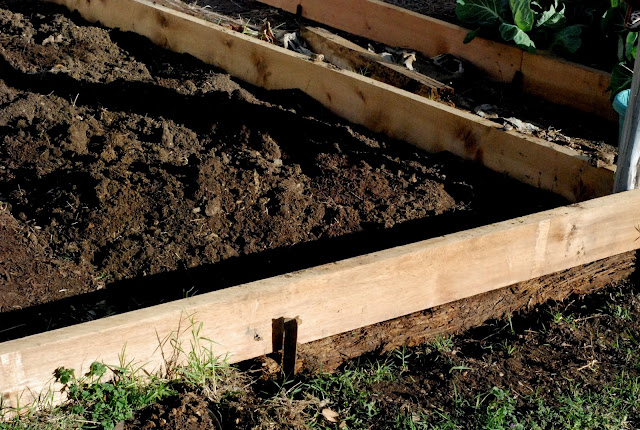
I spent a few hours in our afternoon sunshine working on the Right Bed.

I started the initial double-digging of this fallow bed today. The intense web of grass roots made this slow going.

Slide the spade into the earth.

Pry.

Turn.

Squat.

Sift.

Pick.

Bucket.

Repeat.

Thankfully, the soil in this bed feels lively! It’s loose, crumbly, a little sandy, and full of some healthy earthworms! I haven’t met soil like this before in Texas. It’s exciting to not have to start from scratch with the cloying, airless clay that is all so common in this area. During my digging, I unearthed an old 4″x4″. Pocked and soft with decay, I thought to give it one more task before the earth reclaimed it. The builders of the garden beds used some really nice cedar planks around the edges of the beds. Unfortunately, they left them floating just above the surface. This means that no matter how diligently I remove weed roots now, or weed later, the weeds will wriggle right under the walls and invade the garden. In an attempt to block (or at least dissuade) their wiley ways, I nestled the found board under the edging plank (you can just see it in the picture above.) Hopefully that works at least until next year.

So, what else is going on in this lovely weather?

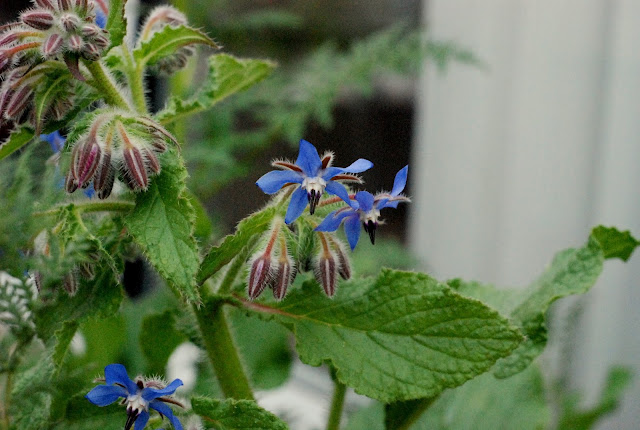
The Borage has blossomed! If you’ve never grown Borage, I find it pretty, but it’s also pokey, and tends to spread, so be careful. Borage flowers taste a little like cucumber and can add a dollop of periwinkle to your salad, or I hear you can even make a medicinal tea.

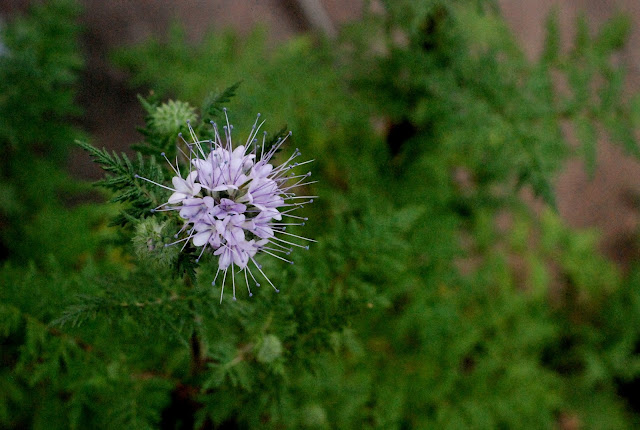
My volunteer fern is also throwing out some food for the bees.

Isn’t that delicate and lovely? Last year was my first fern attempt (Ferns, in Texas? Yep. I’m a rebel.) I sowed them about this time last year, and not many of them came up. Then, early November, with the rain came the flower sprouts. I rather like having a little experimental bed for the flowers to reseed and see what does what. I’m doing just that with the little strip of earth in the back yard between the sidewalk to the patio and the back door. The builders thought to leave 12″ of green space between the foundation and the sidewalk. It’s also only about 4″-8″ deep, depending on where you dig.

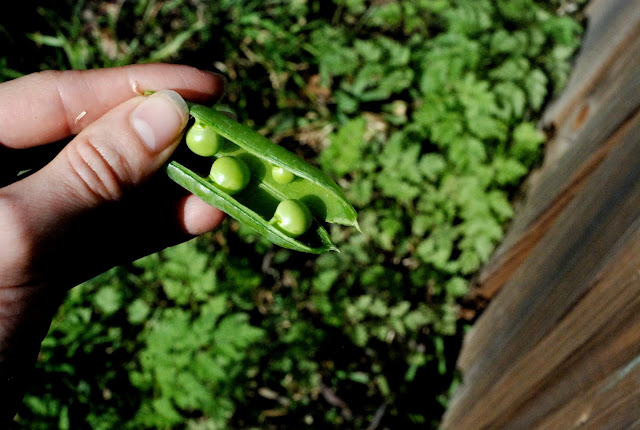
There are many fun things (for me) about gardening, and one of them is to push myself to try new foods – or to have them available to me for the first time. Most recently, I’d only had peas in their frozen or canned form. I managed to right that wrong just yesterday. My first garden peas! (First for me as a gardener, and for eating.)

I thought they tasted great – like if peas and freshly cut grass popped in your mouth. These were simply labeled “English Peas” on their seed packet.

Lamos (Spanish for Limes) aka Bill

Note: Lamos is not actually Spanish for limes. This is an inside joke. The Spanish word for lime is actually lima.

Christmas of 2009 I got DH a lime tree. Someday, he’d like to have an orchard. He dreams of a place where plums and citrus, apples and almonds, avocados and olives all live in happy harmony with the climate. Until we discover such a place, his orchard (currently of the potted variety) must enjoy our Central Texan Climate.

Enter Bill.

Bill, the lime tree, hails from Lake Jackson, Texas. I found John Panzarella online, gave DH a coupon for Christmas for one trip to Lake Jackson to pick out a tree, and that January we were on our way. If you live anywhere near Lake Jackson, and have any interest in purchasing a citrus tree – you need to visit this man. He makes trees that grow lemons that taste like oranges, oranges that look like limes, limes without acid, pummelos, kumquats, and has an avocado tree larger than I knew they could possibly grow. He had fruit that I hadn’t heard of before, and have since forgotten the names of. All of it growing in his well-tended, greatly-loved, suburban backyard.

The first year with Bill, we got about five limes. He got a little spindly looking, so in an attempt to encourage branch development and leaf production, last January when he started to bud, we knocked off his flowers. He didn’t make a single lime last year. He did, however, grow a few new branches with a lot of leaves.

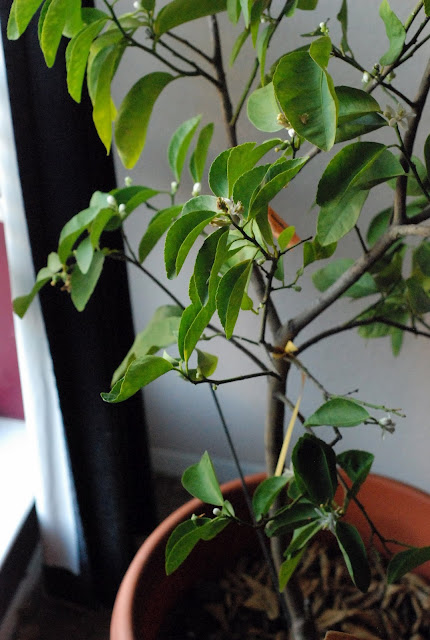
This year? He seems to be making up for it.

This photo hardly shows all of the blossoms visible from this angle – nevermind that this is only half the tree!

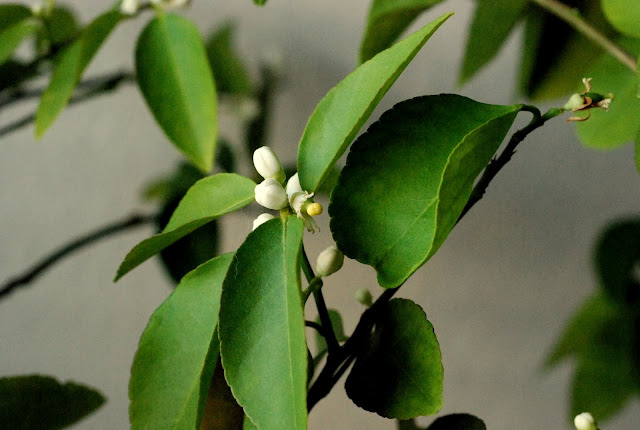
I wish we could put him out side again already. The honeybees adore the sweet blossoms (which smell like limes) and could likely use the nourishment this time of year. Unfortunately for the bees, we’re not yet into our frost-free time and so they must wait a few more weeks.

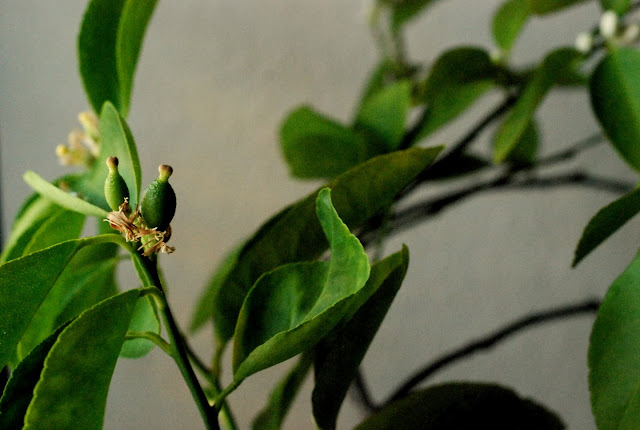
The buds start out small, round, and green. As they grow, they blanch into little popcorn-looking buds. Finally, they open into flowers only to have the petals fall away and a baby lime with a yellow nose appear.

I do think that this year, for the first time, we may end up with more limes than we know what to do with. Lime sorbet, perhaps? Lime juice ice cubes for drinks throughout the summer? I’ll have to look up some more ideas.

Right now, Bill is in a sizable plastic pot. This is his third pot while in our care, and it keeps him at about five feet tall from pot bottom to tree top. While we would love it if we could plant Bill out and let him grow ever larger, there are occasional freezes here that would put an end to Bill all together, so he must stay small enough to be carried indoors for 3-4 months of the year.

DH does want to see if we can prune him short, but allow him to gain some strength and heft, by increasing his pot size once again. To that end, DH put together a quick project.

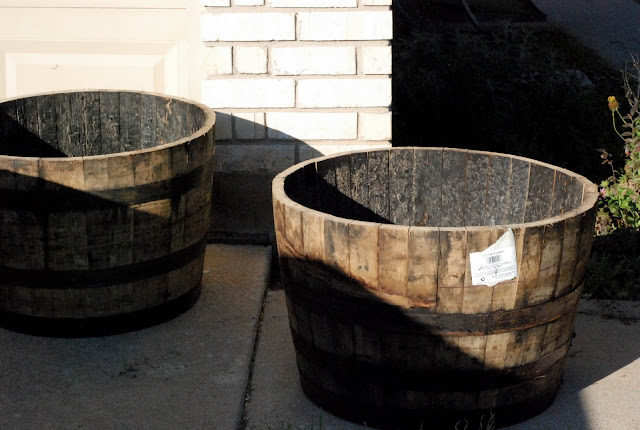
Step 1: Buy a barrel cut in half.

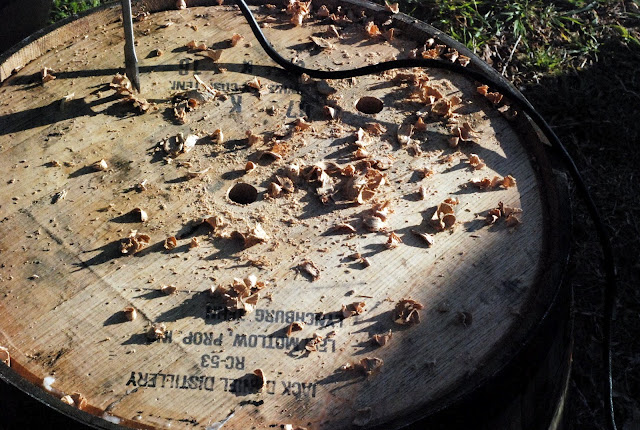
These are from the Jack Daniels distillery in Eugene, Oregon. Having lived in Eugene previously, I wondered upon discovering this fact if they were any cheaper directly from the source. After factoring in travel, I was actually kind of surprised (and glad) they were priced at $30 each and not higher.

Step 2: Drill drainage holes.

This will prevent root rot for larger plants planted in the planter.

Step 3:

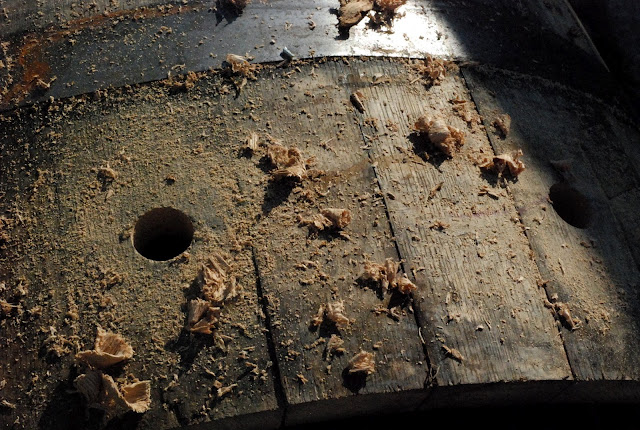
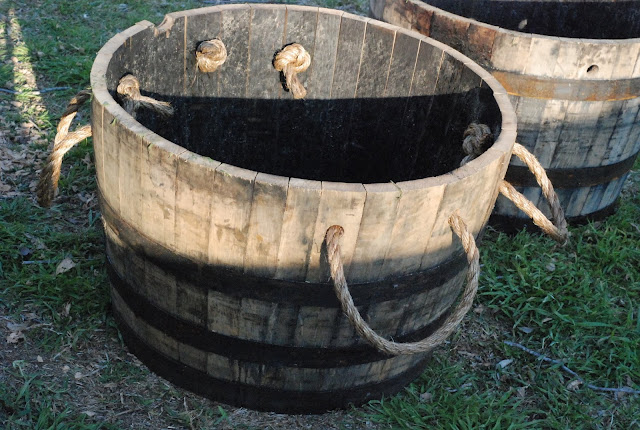
Set the barrel on its side, brace it so it doesn’t roll away, and drill handle holes.

The pot Bill currently lives in has no handles. When full of a tree and the soil necessary for the tree, nevermind if that soil happens to be moist – the pot gets heavy enough to bend the plastic when being carried from spot to spot. Thus the need for handles on an even larger, heavier, pot.

Step 4:

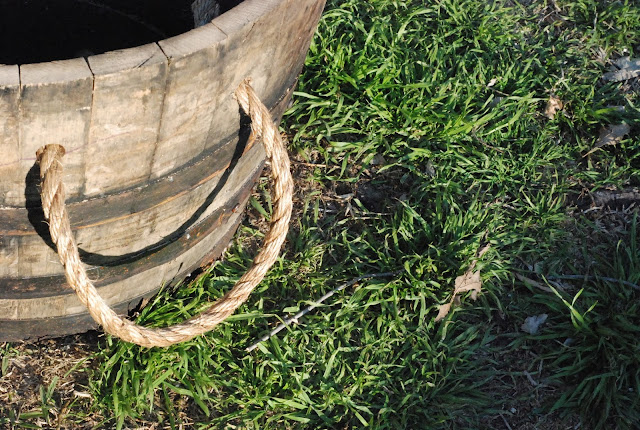
Buy some strong, thick rope. Cut to length. Thread through the handle holes, and knot off.

When cutting the rope to length, remember to add some length for the knots, as well as enough rope that when you lift the handle your knuckles don’t bump against the barrel.

I had originally thought two handles per barrel half would be perfect. Each person has a handle with which to carry the pot. DH had a better idea.

Things I learned that day: Two people, four hands, four handles.

The plan was to move Bill from his current pot into one of these when he made the move back outside. However, with the level of joy Bill is showing off through flower and fruit production in his current pot, we won’t be rocking the boat. So until next fall when we do swap pots, these will likely house some flowers, a few herbs, and hang out by the grill on the patio.

The weather outside is weather…

It was 88 degrees on Thursday. Today was a high of 63. It’s supposed to be 40 tonight.

Seasonal changes where I grew up in the Pacific Northwest of the United States were gradual. Days slowly got drier and warmer as they got longer in the spring. In the fall, they slowly lost daylight hours to night hours as the temperatures mosied down the thermometer until winter. Texas is different. Central Texas is a fan of a 40 degree temperature drop in a matter of hours. A cold front comes in and that’s that. The humidity is pushed out, the sky clears, and the temperatures plummet.

Thursday, I took my tomato and pepper sprouts outside for the first time and worked in shorts and a tank top and was warm. Today, I was in jeans and a tanktop while shoveling a cubic yard with DH. Tonight, I’ll be bundled in pants, long sleeves, a jacket, hat, scarf, and gloves. Oh, how the winds change things.

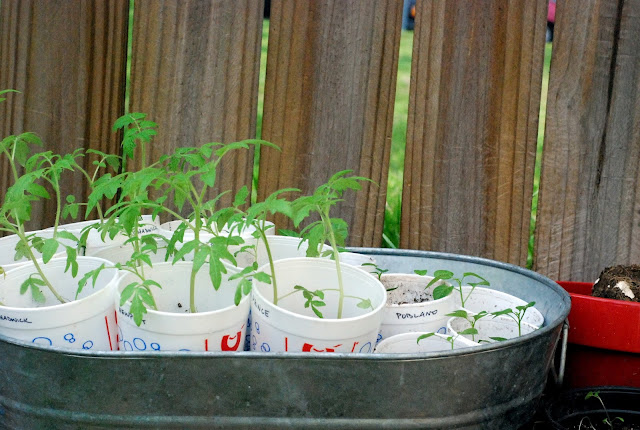
Each year so far I’ve forgotten how the peppers stay small for so much longer than the tomatoes do. These tomatoes were the usual little leggy sprouts in a tray, that got planted up to their necks about a month ago. Here they are, ready to be buried once again.

What else is the weather doing? It’s bringing things to life. This is June. (We name things in our household. Not all things, but more things than I think most households name.) June is a grafted plum tree. She houses four varieties on her delicate limbs. She came from Raintree Nursery late last spring.

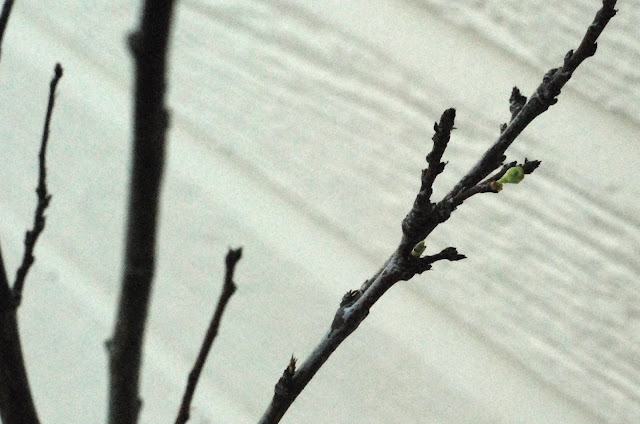
June thinks it’s time to bud, and it very well may be.

Speaking of things that it’s time for…

Each year for the last few years DH and I have gone camping for our anniversary. It gives us a chance to be out in the quiet wild of the world, spend time with each other away from the laundry (but not the dishes), away from the world of now-now-now, away from cell phones, laptops, work, and people, and just be. We had planned to go this weekend, and oddly both of us, as we were set to start packing the car, looked at one another.

I didn’t really want to go. He spoke up. “Do you really want to go? You don’t seem that excited.” I wasn’t. It turns out he wasn’t either. So instead we’re doing some homesteading/nesting for our anniversary weekend. Part of that is putting in some serious labor on the new garden plots.

Yesterday, DH spent a couple of hours turning the rest of the Left Bed to aerate the beaten down, lifeless soil. I followed behind on a beam of wood that distributed my weight evenly so as to not re-compress the soil, pulling out bucketful after bucketful of weeds. We even found a potato and a beet the previous gardener had left behind! For some reason, our dog, T, thought that potato was the most fun that could be had at that moment and spent the next twenty minutes tossing it into the air to himself, chasing it down, and tossing it again.

Today, DH drove us in his little truck to Whittlesey’s for a cubic yard of soil. We ended up getting their Austin Soil Amendment. 66% organic compost, sand, and other nutrients to help feed the earth and break apart our dense clay. The mix sparkles ever so slightly in the sunlight. We spent the afternoon with two shovels, a wheelbarrow, and a lot of back muscles. With a little final work with a hoe and a rake, the mix was spread evenly across the 200 square feet.

Tomorrow will be a trip to the lumber yard for enough 2″x6″ beams to make two foot-wide paths twenty feet long. When those are in place, I’ll turn the amendment into the soil, sow a couple hundred drying beans, water, and move on.

Move on? Well, yes. There’s a-whole-nother 200 square feet that needs to be weeded, turned, amended, and structured.  That bed needs to be finished next weekend so the tomato and pepper plants can settle into it before the heat really comes to stay for good.