Tag Archives: tomatoes
A homesteading kind of day

A little sandwich bread for the week thanks to my 40ish year old Joy of Cooking.

A pan of frozen tomatoes from the garden abundance of 2012 willing their way into spaghetti sauce (with DH’s deft assistance.)
This year’s winter garden is crawling along the cloudy days. Cabbage and chard, broccoli and kale, garlic and onions, and some pea and lettuce sprouts crossing their leaves for the harder freezes being over for the season.
I don’t think I would’ve managed a winter garden this year without DH. He hauled the manure and turned it in. He gathered (*cough* nicked from the curb *cough*) leaves for insulating (and feeding) mulch. He’s kept a mind on the watering and an eye on the forecast. He’s been truly wonderful (per usual, honestly.)
Why all of the extra help? The ankle is still healing and physical therapy is progressing, but these days, more than that, is all of the energy I’ve been allocating to growing something else 😉

Putting up harvests, eating our colors, and late fireworks.
I’m going tomato-picking again tomorrow! Last harvest was a few days ago. Any guesses how many pounds we’re up to?
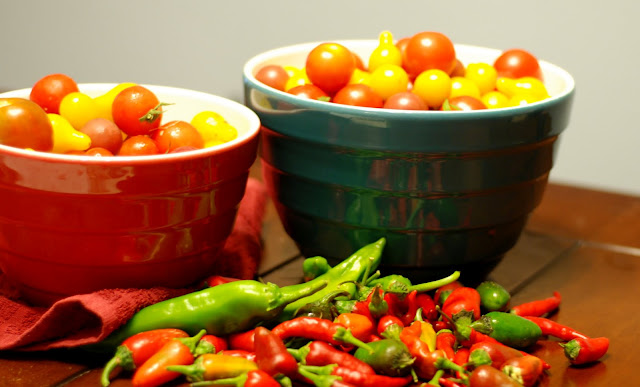
These went to DH’s mother, the freezer, a giant batch of pico, and some grilled peppers.
I learned on a Victory Garden episode a few years back about dehydrating unusual things. One of those things was zucchini. The idea being you can dehydrate zucchini, carrots, and other things in season, store them in the pantry, and then when the winter doldrums set in and you’re needing to make soup – voila! You have some summer sunshine in your soup.
I have yet to make the soup, but am starting on the dehydration experiments. My first batch was actually dried last year, and is still in tact – dry and happy.
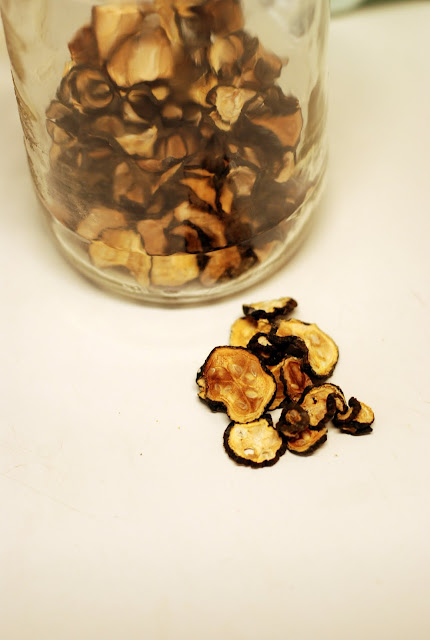
It’s a handy way to store some of that summer squash excess a few of you in cooler climates may be in the throws of. I cut these about 1/8″ thick, laid them on a cooling rack (like for cookies) and left them in a rarely-used cupboard, forgotten. Last week, we had a few too many squash in the fridge about to turn. I took out the mandoline, set it on the “paper thin” setting, and went to town. 24 hours in our turned-off gas stove later and…
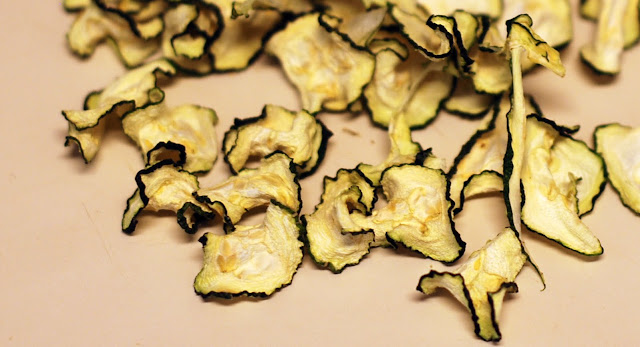
I’m not sure how these will reconstitute in a soup. They’re nearly translucent, and I’m thinking they may simply mush when they hit the soup this winter. Only time will tell.
What about what we’re eating now? We’ve been playing more with the mandoline and making fries! We’ve made beet fries from some Chioggas, which also just came in the mail in the form of seeds to sow soon! I didn’t grow any of the tubers in the pan below, but perhaps someday.
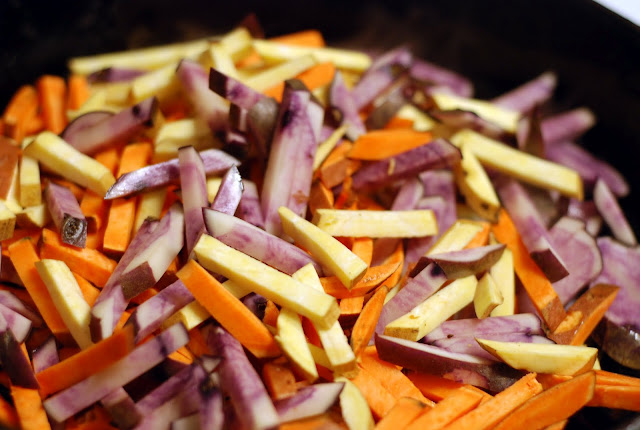
Here we have some organic sweet potatos – orange and white, and some blue potatoes as well. Can you just picture that same pan with some Chioggas in it?
And, after all the worry over how the summer would be this year after last year’s insane heat and drought, we’re having a nice (and surprising!) July. The thunderstorms that passed over our heads week after week last year without letting loose a single drop (only to unleash on the midwest and cause horrendous floods) are unzipping their buckets of water almost every other day these days.
For being drought tolerant, this spongy-leafed sprawler sure puts on a show with regular watering.
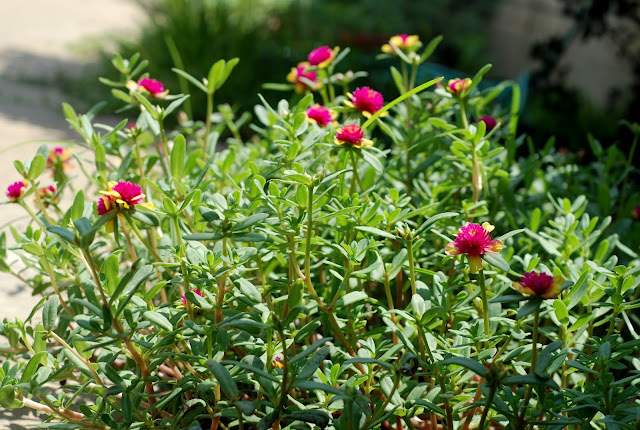
These are blooming just outside our garage door. The very same door we propped a ladder against to climb on the roof and watch the fireworks two weeks ago for Independence Day. A little delayed reflection of the explosions in the sky.
The last two hours of light.
I’ve never so enjoyed two hours of pulling weeds. With our dog on a longer rope to wag his way to greet any wandering garden neighbors, my big floppy new garden hat, and my mud-stained leather gloves, I squatted in the garden and pulled weed after rooted weed and lobbed it at the stone wall. The sprawling kind with the fragile arms. The tall ones with the white pillar flowers. The ones like those, but deep purple. The ivy. The frilly crawling ones. One after another, the hit the wall and fell to the earth. Soon there was a spongy bed of pulled weeds along the wall and a clear patch of earth between the peppers and sweet potatoes where for months there had been a growing bed of foliage.
Now the fish peppers are free to stretch their stripey fruit and variegated leaves toward the sweet potatoes.

And the sweet potatoes, they have a bit of a head start on the reaching-toward-the-peppers…

With the weeds gone, I marched to the tool hut for a shovel and wheelbarrow. Our gardens are supplied with a regular pile of mulch that composts nicely. The hut was sans shovel. It was then that I remembered the hut had been sans shovel for months. That’s ok. I’d learned last time that a wheelbarrow tilted just-so with a hoe to pull the mulch worked as well as I needed.
I tilted the wheelbarrow just-so. I pulled the mulch into it. Tilted it level. Backed it up off the mound and…nada. The wheelbarrow wouldn’t move. Perhaps I was in a hole? Check…nope. No hole. A completely flat tire? Yeah, one of those.
I went looking in the tool hut. There were two new contraptions. They’re like buckets, with tall backs like chairs, that have handles in the back and wheels on the front. Handbarrow? Not sure of the actual name, but it would have to do the trick. It worked surprisingly well! It only held about half of a wheelbarrow’s worth at a time, but was easier on my shoulders than a wheelbarrow. I don’t think it would work outside of a well tended path area, but for a place such as our gardens, it seems kind of perfect.
I hadn’t planned on watering, but with the triple digit heat before this “cool spell” and more heat expected, I figured the last hoorah of tomatoes could use the extra juice.
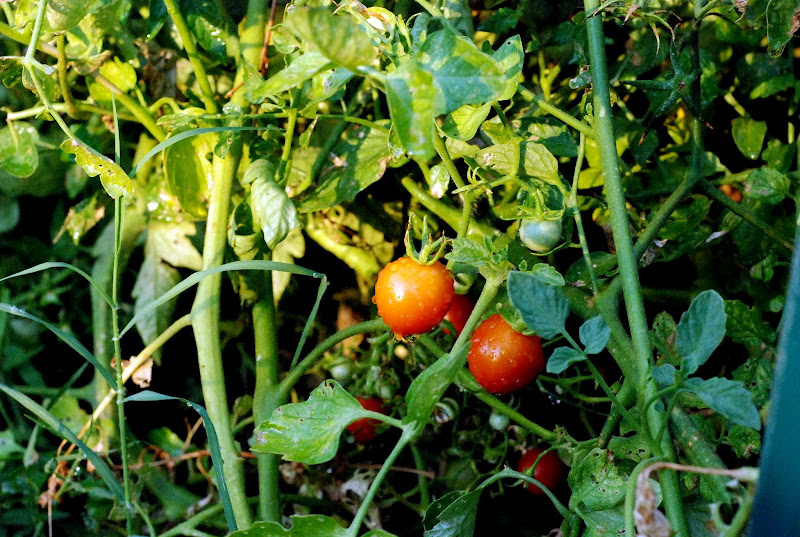
The tomatoes are definitely slowing down on production in this heat. Last year production didn’t make it until July, and this year the later heat and additional rainfall (additional? I mean the fact that there was rainfall at all) has them still going for at least the next week or two.
As much as they’re slowing down in production, they’re still growing. The camera is sitting on the top of a T-post, five feet tall.

They’re getting taller. Last summer my Cherry Chadwick vines were 15 feet long by the time the first frost hit in November. As they get taller, they point out the weaknesses in my trellising plan. These aren’t the tallest vines, they’re just the ones that have yet to fallen over. The others have all fallen over. They don’t fall sideways, because of the twine. They instead fall down the line, between the lengths of twine. This keeps the picking areas as clear as they have been, but it creates such a deeply thick jungle of vines and leaves, that the fruit is hidden from view. A little tomato hide and seek.
I know the Cherry Chadwicks, and the Black Princes will make it through the summer with careful water management and send a second harvest into the world after the heat of the summer has passed. I am excited to see if any other varieties do the same.
The year of the tomato.
I thought I got a huge harvest on June 8th. Look at all those bigger guys out of focus in the background!
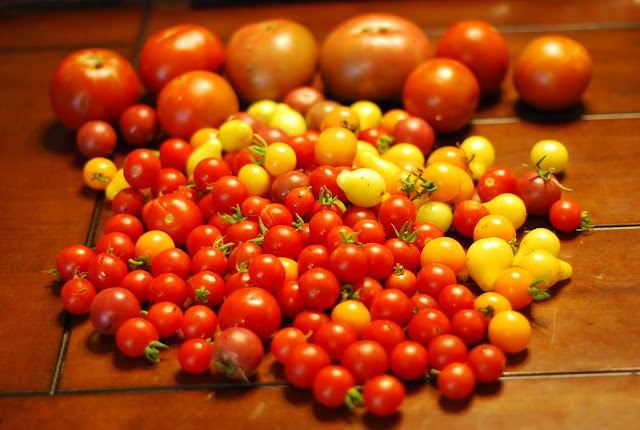
And then, on June 14th, I put the 8th to shame. Nearly twice the harvest as before!
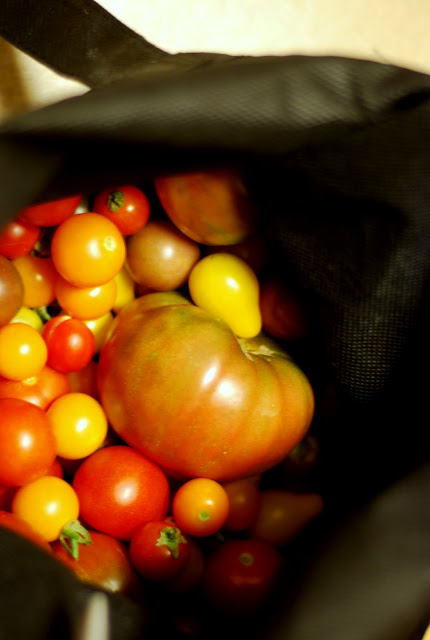
Sunday, for Father’s Day Birthday, DH’s family came over for dinner and afterward wanted to head to the garden. It was really neat walking around the gardens with them. Oooh and Aaaahing over the giant gourd squash, the comically huge sunflowers, the beautiful squash flowers, and the mystery corn-grass in others’ plots. It was also fun to hear them get excited over all of the ripe tomatoes in my plot like I do. Once again, the harvest left the previous harvest in the dust. Once again, the latest harvest was double the previous.
Want to see what (at least) 10 pounds looks like?
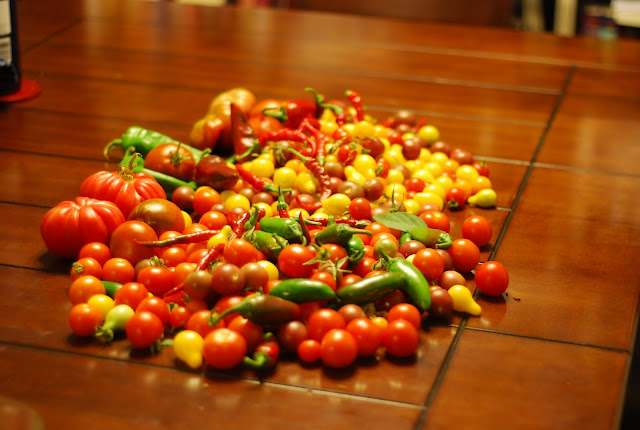
Why only “at least”? Well, the scale broke. I thought it took regular batteries, and knew it had been dying slowly. It finally died, and I go to replace the batteries…giant watch-style batteries. Crap. So we’re guessing on the weight this time.
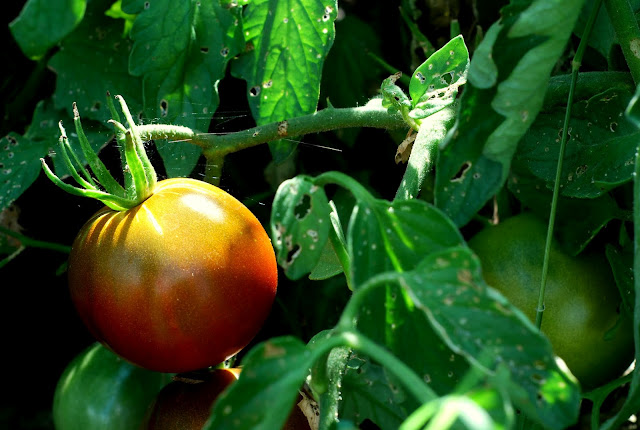
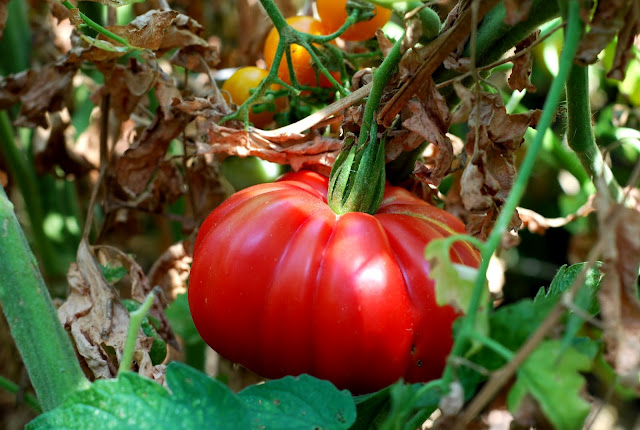
That morning I snapped a shot or two of two of the large varieties in the early light. The Black Prince (so named for the dusting of darker green/purple shoulders) and the Zapotec (the pink wrinkly one.)
Sprouts!
A few days ago, the first little white wriggles of onion life appeared…in half of the tray.
Things I learned:
1) Seed trays with high side edges need to be rotated to allow for even sun exposure.
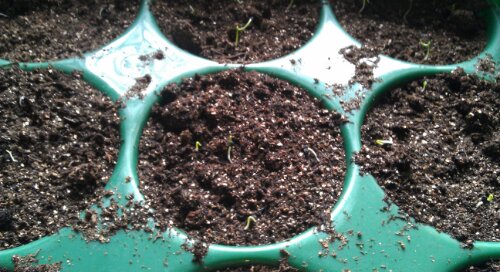
Now is a vital time in the little sprouts’ lives. They don’t yet have a root system to sustain themselves through drier times, so it’s even more important for me to remember to mist them every day than it was before they sprouted. An unsprouted seed may still sprout, but a dead sprout is mere compost.
Last night I was still without any tomato or pepper sprouts. That was ok. It was still early. I almost made it to bed without watering them, though. The heated soil dries out more quickly than the room-temperature onion soil, so I skipped the spray bottle and gently poored water over the surface.
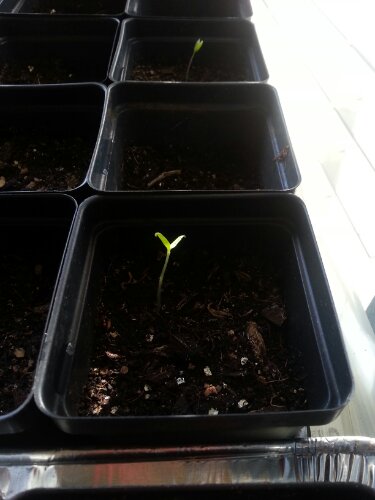
This morning:

The odd looking fellow in the corner is an unhappy Donkey Ear offshoot. I need to move him to the succulent pot.
Most exciting about these first tomato sprouts is that they are saved seeds! The ones on the left are from a local farmer’s market, where you can purchase a pint of mixed miniature rainbow tomatoes. The ones near the top of the photo are from a farmer’s market in Newport, Oregon.
And while there’s all this excitement already, the mailman delivered even more excitement:
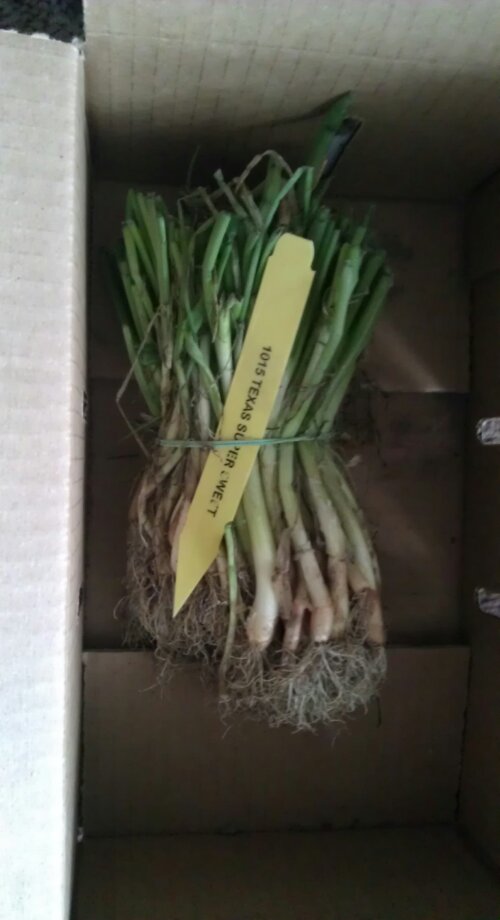
These will come in handy in two ways.
1) I can plant these in the garden in a few days or a couple of weeks, depending on my taste for risk taking.
2) If my onion sprouts from seed turn to compost again this year, I have these for Plan B.
Ordering starts like this is also handy because I don’t have to plant them right away. They can hang out just like they are for a few weeks, feeding off their little bulb.
Being the cautious adventurer that I am, I’ll put some of these out this weekend, some out in two weeks, and the rest the first weekend of February.
Also this weekend:
– Starting seeds for beets, kale, collards, and other pre-FFD greens.
– Hopefully a road trip east for some cheap organic manure
– Continue addition to garden bed
– Soil testing and amending as needed
– Research soil desires of blackberries, melons, and ground cherries.
What is going on in your neck o’ th’ woods?
Growing from seeds – Tomatoes and Peppers
I try to grow my garden from seeds as much as possible. My first garden (and second, and third…) watched sprouts appear through the glass, but never held the plants in their soil. Why? For one reason or another, it took multiple rounds of trial and error to succeed in getting seeds to sprout, those sprouts to thrive, and those seedlings to harden off properly and make it to harvest outdoors.
Last year, I solved the Great Pepper Secret.
1) Sow seeds indoors weeks before final frost: check.
2) Use seed starter mix*, or your own mix of lighter soil particles: check.
3) Keep seed bed evenly moist**: check.
4) Place in sunny window***: check.
I waited. I misted. I kept it humid. I waited some more. I checked the expected time for germination on the first seed packet, and the second. “First sprouts to appear in 7-10 days.” “Days to germinate: 10-14 days.” I was two weeks in and then some. Nothing. I checked my books. I read forums online. Finally, I reread the seed packets.
And there it was. The missing piece. “Soil temperature for germination: 75-85 degrees F.”
Well, didn’t I feel a fool. It was January. My house was lucky to hit 70 with the heat on. I needed to warm up the seeds without killing the heating bill. Online digging lead me to “seed tray mats.” Funny. Those look like big heating pads. I had a heating pad. Free and less-stuff-friendly!
I remove the fabric sleeve to avoid any stains it may acquire, set it.on.medium, and voila!
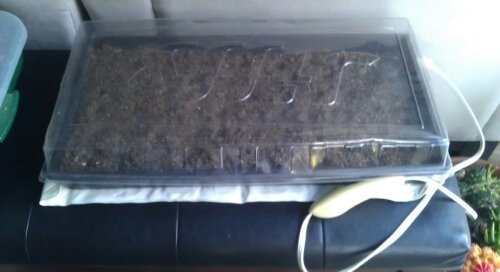
Due to the added warmth, I mist it at least once a day, and check it twice a day to make sure it’s not too dry.
Last spring was a proud season for me. Each plant in my garden bed was grown from seeds in my entryway. (My lovely Other Half quietly and patiently awaits the day in March when the entryway is Obstacle-Free.)
This year I have some new seeds to try for the first time,
– Melons
– Winter squash
– Ground cherries
– Beets
or for the n-th time (so far without successfully reaching harvest.)
– Onions
Any experience with the above? Any tips to share?
*My first seed attempts involved regular soil. Results were less than exciting.
** My next mistake was to water as often as a houseplants, which is to say, not nearly often enough and with much too much water.
*** Indirect morning sun is not sufficient. Lesson learned 2009.
Onions, Peppers and Tomatoes! (Oh, my!)
It’s seed sowing season here in Central Texas. We’re approximately 10 weeks away from the average final frost date. Approximate, because it depends a fair bit upon one’s location relating to “town bubbles” as well as possible elevation and other microclimate factors. Not to mention the conservative approach versus the riskier approach – which is an entirely personal decision.
I like to start my seedlings indoors when possible, as early as possible. If I start them earlier, and am unlucky with my germination, I may have time to try again. At the least, the local nurseries won’t be sold out forcing me to buy from a big box store if I want plants of that type.
This year, right after planning my garden plot on some graph paper, I re-reminded myself on the date to plant or sow relative to the the Average Final Frost Date here. Risky, or conservative (depending upon to whom you talk) I call the FFD in my neighborhood March 15th. If the 10 day weather forcast is looking lovely on March 8th, I’ll put seeds out early. If it’s sketchy, I’ll hold off.
With my memory refreshed, I started my timeline. March 15th, minus ten weeks, is approximately January 5th. So I’m a week early. The plants will merely be a week bigger.
This is a seed tray made from a clearance item at Home Depot. Apparently people store ornament balls in these. I use them as easily measured seed sowing “plots.” It even has a lid for humidity! (Thanks to my mother for finding it and suggesting its use.)

Some folks are talented and resourceful enough to make their own seed starting mix. I have yet to dive into that project. Instead, I keep an eye out for off-season sales. The bag shown had four friends just like it, at the grocery store of all places.
This tray has five seeds per circle laidout as a square with a dot in the middle. Forty Australian Brown Onions and forty Violet de Galmi. I don’t have a historically successful time with onions, so I thought to plant in excess and succeed at least a little that way. Sown on the 28th, I hope to see sprouts next week.
Today’s sowing was peppers, tomatoes, and their relatives.
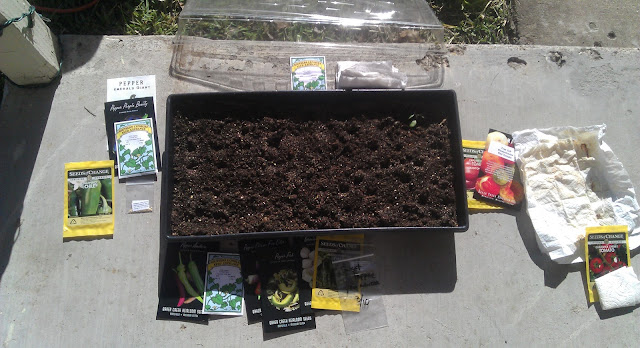
This is an actual seed tray, same mix. You can just see the indentation of my finger making spots for each seed. I lay the seed packets out in order of sown row. Then after I’m done, I sketch the seed tray with dots representing each seed, and label accordingly. This is how I will tell which seeds germinated well, which seed sources may gain more of my business, and also simply so I don’t end up with a tomato wishing to grow 8 feet tall in a pot where I thought I put a 2 foot variety.
Have you started any seed trays? Do you plan to? Or is it too soon in your area?
 plumdirt