Who has a guess as to what this guy is?

Not the onions it decided to grow among, or the squash leaf in the background, but the other thing.
Who has a guess as to what this guy is?
Not the onions it decided to grow among, or the squash leaf in the background, but the other thing.
Work has been taking up all of my daylight hours, some of my hours of darkness, and nearly every ounce of energy these past two weeks. I haven’t been in the garden at all in over a week, and miss it. I’ll be taking a wander around the bed at home to pull volunteers this afternoon. I have some serious Garden Time planned for this weekend. Hopefully the planets align.
In the meantime, a quicky:
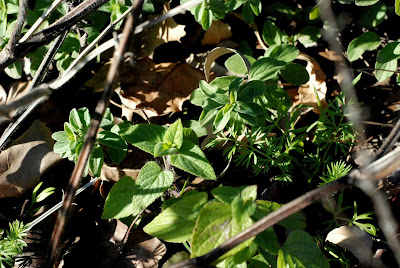
Those two main sprouts in the middle? The lower left one looks a little like the Mysterious Purple Flowering Weed (Henbit), unless I look more carefully. The leaves are pointed, instead of scalloped. The leaves don’t grow in a strict tier pattern, but instead sprout in an every-other-tier habit. Hmm…
Oh, wait! I looks like the larger pointed-leaf specimen in the foreground, which looks more like…yep! Another two Texas Hummingbird Sages!
Of the two in the middle, the one toward the top right is a different fellow. His leaves are smaller and more frequent. I touch them and bring my fingers to my nose. I inhale the sweet tangy aroma of Oregano, and know that the prolific seed production of this past fall wasn’t for naught. Depending on how many of each of these herbs end up sprouting where they are, I may end up transplanting a few into pots for the patio to add hunger-inducing smells, handy herbs for grilling, and pest deterrents for the yard.
I have yet to compost my compost entirely. Every year I think I’ll make multiple piles and finally let a compost pile fully “cook.” Every year the time rolls around to work more into the soil and the “more” is “not done cooking.”
Hopefully this isn’t hurting more than my weeding time allotment.
One thing this cycle has taught me, is what a lot of plants look like when they first emerge. This is super helpful when it comes to growing something I’ve never grown before. For instance, beets.
This is my first year trying to grow beets, and I had no idea what their sprouts would look like. I did remember to mark down how many I put per row, and how many rows. There are a whole lot of sprouts in that little corner of my garden right now, and before any get too crowded or too large, I thought to discern which were the beets, and which were volunteers.
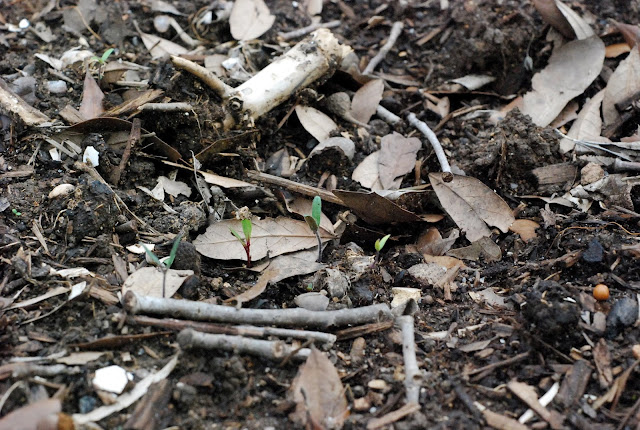
In this picture, my first thought was that the red stemmed little guy was either chard or marigolds (both have had red stems in my experience.) Then I notice the sprouts on either flank have soft purple stems. I know that means tomatoes (based on the options from what goes into my compost.) The wee one on the right of the other three is what is throwing me off. It isn’t for sure a tomato, or pepper, or squash. So it’s possible the beet sprout is either another red-stemmed one, or another purple-stemmed one. Either with brighter leaves or paler leaves than the similarly-stemmed counterparts.
How I know it’s not a squash?
All squash so far in my garden volunteer looking like this:
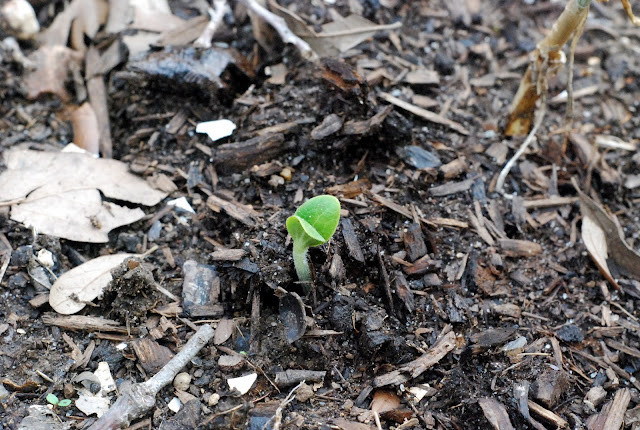
Last spring I stopped counting after pulling 87 of these from the garden, transplanting 23 more into pots, and leaving 8 in the bed. I’m actually hoping this is the weird bowling-ball squash that volunteered last year (that I’d never seed before, or since, but tasted like savory butter with a hint of lemon.)
So I keep looking, puzzling over which sprout a beet sprout may be. And I come across this pair:
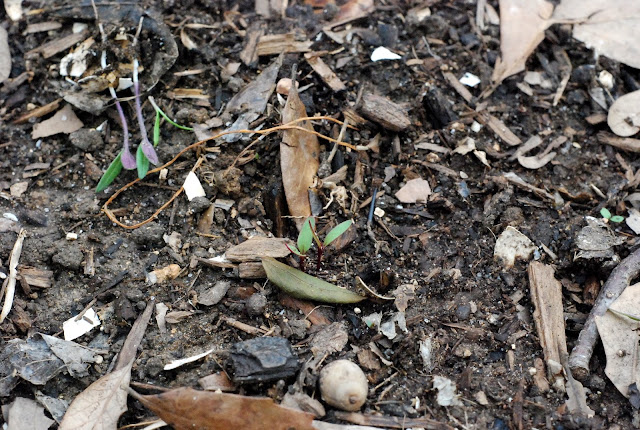
You can see that I’ve pulled some tomato sprouts already and laid them on the earth. I like to let them compost right back into the soil. The duo in the middle are more of those red-stemmed bright-leaved folk. Being as there are two, I think they may be a volunteer pair and am about to pull them. My eye traces up though, and there’s another pair. And another. And then there it is, the original red-stem. All in a row. All evenly spaced. I gaze to the left. Another one, splitting the center of the two in this row. Down that row, it continues. Eureka! Beet sprouts identified. Everything else (except the squash) comes out.
I’m hoping that squash will grow as quickly as last year and I’ll have some fresh squash by Mother’s Day again.
Depending on the type of sprout, I either learned what it was through elimination (like I did today with the beets), through growing it indoors in an isolated environment, or through coming across a dense patch of sprouts, digging, and finding the source.
For instance, I now know that these are tomatoes. If I didn’t, I could dig about an inch down and find a partially decomposed tomato – probably of a cherry variety, knowing this household.
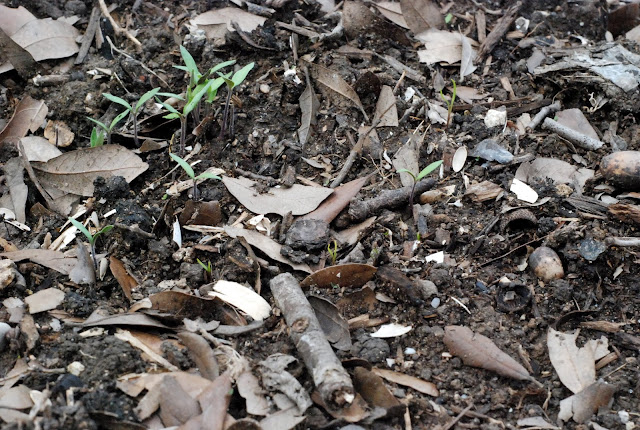
And I think the sprouts at the end of the stick pointing up the middle are carrots, but I don’t honestly recall. There are supposed to be carrots in this area. These ones get to keep their feet in the ground until either showing off some carrot leaves, or revealing a coat of a different color.
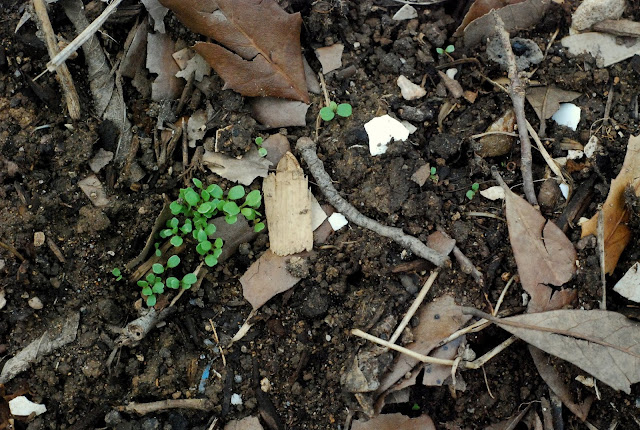
This patch however, is new to me. I haven’t gone digging yet. Any ideas?
Things I learned today:

It sprouted in my veggie beds, from premature composting (a habit I can’t seem to kick.) The seed it sprouted from was large, and roughly resembling a squash seed. A sucker for a good mystery, I saved it from the spading and put it in a seed tray indoors. Let’s hope it grows large enough to solve the mystery!
I didn’t use to plant flowers or other landscape plants. Last spring was my first venture into things that weren’t edible. I justified this change in two ways.
1) I had a lot more space than I ever had before. It is a smaller lot, so far as city lots go, and no where near having “land” in the sense I grew up with, but it was enough space to justify non-edible space-takers.
2) I was only going to grow things that were edible to other creatures – mostly bees. As much as I like birds, attracting birds to the same plot of earth that I use to grow food for us is asking for trouble. I already have to fight them for tomatoes as it is. As for the butterflies, I figure if the bees like the flowers, the butterflies may as well.
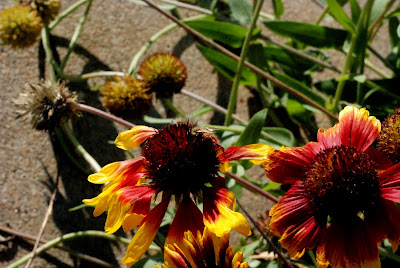
Aside from how cheerful Blanket Flowers are on their own, they make me even happier for their year-round supply of pollen for the bees that haven’t gone into hibernation.
And while we’re covering pleasant surprises, here are two more.
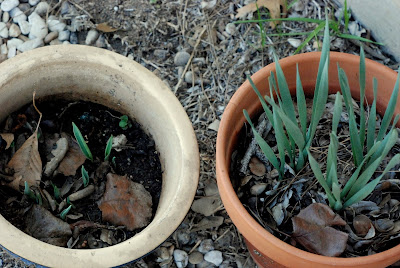
I had completely forgotten these pots had bulbs in them. I haven’t watered, fed, or otherwise cared for either of these in over a year. Nevertheless a few weeks ago, the tulips started to poke their heads above ground. Shortly thereafter, the ranunculuses popped through the soil. I’ll toss them a bone (in the form of bone meal) and some compost, keep their water up, and see if they won’t bloom this year.
 plumdirt