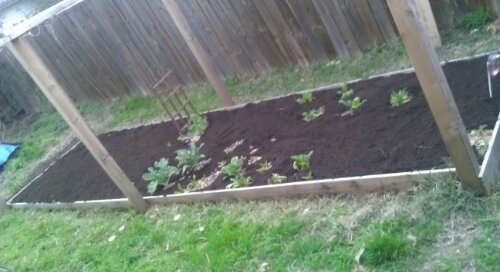
The outside world.

The weather today was absolutely lovely! I couldn’t wait to get out into the air, the sun, and the earth.
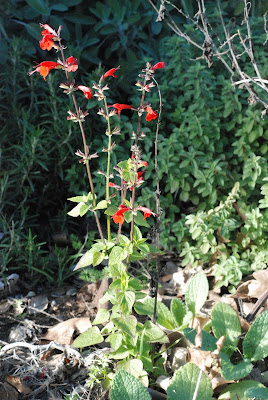
This little guy is doing his part to keep the bees fed in January. This is a self-sown Texas Hummingbird Sage. Last spring was my fourth attempt at growing Texas Hummingbird Sage from seed. (Trial & Error often requires multiple trials!) I managed to get four little seedlings to put out two sets of “real” leaves. I put two in the front bed, and two in the rear bed. The rear bed ones didn’t make a week, baking in the sun if I missed their morning water. The front bed was a little kinder, and both sprouts made it about four inches high. I couldn’t figure out why one died, but I suspect a bird or other creature thought it would make a tasty salad. That fourth stubborn sprout ended up surviving all summer long and into the fall before the first freeze took it. It topped out about 18″ tall and had bees on it every day! This little guy shown above is an offshoot from the base of the old plant.
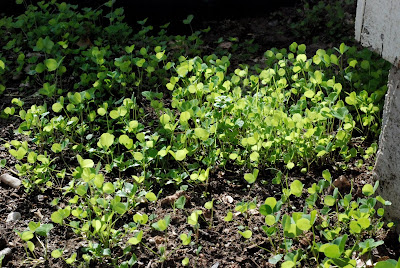
Growing up in the Pacific Northwest, one of my all-time favorite seasons was a short one. In the Willamette Valley (and I’m sure elsewhere) farmers plant a cover crop of red clover. In May, the fields are abloom. Mile after mile, acre after acre, are afire with crimson blossoms on rich green stalks. They only last a week or three, but are one of the things I miss most about that corner of the world. This clover-looking mess is actually my own little patch of Crimson Clover. It’s my first year with it (second planting attempt, the first one died off due to inattention (oops!)) and I’m hoping to get a bloom or two. It’s a new bed that previously only held Horse Herb (a weed, in my estimation) and a Hackberry. I amended it a bit with manure, blood meal, and bone meal. We’ll see how it goes. I’m glad to see them hanging in there, as that is also where a lot of water from our gutter-less roof runs off.

And finally, the front of the lawn. I decided a few months back that I wanted to absorb some of the scraggly lawn into a native bed for the bees and butterflies. My parents were kind and generous enough to send me some of my Wish List Plants for Christmas in order to get it started!
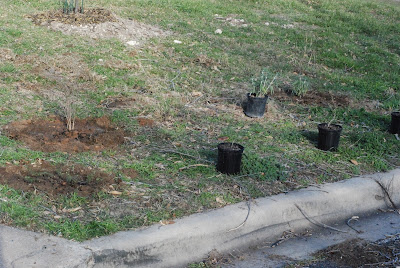
In the top left corner, you can see the dirt dam and mulch of the new Mexican White Oak. Down the left edge, you next come to a brown circle with a few sticks visible – that’s a Fragrant Mimosa. Unbeknownst to me, but quickly discovered by my other half – it has thorns. Be mindful if you choose one of where you plant it! Continuing down the lefthand side of the photo is another brown circle, this one contains a Prairie Verbena! Moving along the curb we have a few Black Daleas still in their pots, and behind them, one in one out, are two specimens of Mexican Bush Sage.

All of these plants my folks were able to order online from a local business (bonus points!) They’re called Landscape Mafia, and not only do they have a nice variety of natives, for very reasonable prices – they deliver! My parents live far away and ordered shipping. The folks at Landscape Mafia had the care for their plants, and the presence of mind, to realize that I lived a short drive away and some nice man from their staff delivered them directly to my front porch! Color me impressed.

Since these are natives, who all claim to not want super-rich soil, I worked a little manure into the soil of each spot, watered deeply, and that’s it for now. Tomorrow I’ll put the others in the ground and see how I feel. The ultimate goal for this spot? No grass, these big “anchor” natives, and a sprinkling of Black Foot Daisies, Henry Duelberg Sage, and maybe because they make me so very happy that I surely need more:

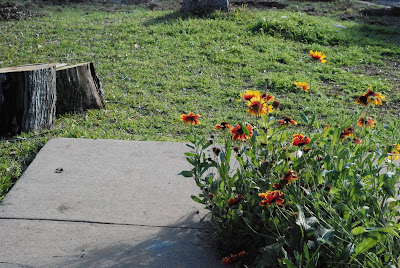
Blanketflowers!
 

Last weekend, the tree went down.

The sun is setting on the day. A sun shiny day with chilled crispy edges. The tree hadn’t leafed out in over a year. I’d never seen it leaf out completely. It was slowly shedding the bark from its truck near the earth. A large branch toward the street, and another toward the garage, were cracking along the length. Inch by inch, day by day.

The main truck was trying. It was sending out small little sprouts with single or double leaves. The branch near over the drive and along it were done for, we had to let them loose weeks ago. I did some recon for a replacement, at Green and Growing up the road, and with a final vote from my other half we picked up a Mexican White Oak (aka Monterray Oak.) We believed our previous tree to be a Silver Maple, and it was quite large for a younger neighborhood tree in Austin – possibly topping forty feet. We did water it this summer via the lawn during the 2011 Drought, but believe the damage had been done the previous year. This is a rental, after all, and not all tenants have the time, desire, or funds to water their landscapes.

Saturday, as the sun started to mosey down the sky, the chainsaw started up. With a rock captured in the end of the Gypsy Rope, lobbed over a high branch, and tension to pull the limb from the house, the chainsaw started work.

It was dull.

Off to the store for a new chain. Meanwhile, we kept progressing with the ax. There’s something satisfying about the heft of an ax. Slip. Swing. Thunk. Slip. Swing. Thunk.

“Get ready!”

We pulled on our ropes. Slip. Swing. Thunk…craaaack…CRASH. The branch near the house was down. The branch pointing to the streetlamp took longer, but came down into the road.

Sunday, new chain at the ready, it was time to bring down the tree. When firewood was made and loaded for family, the job was done. Any concern that I may have decided to remove a healthy tree was relieved when we had done so. The center of the trunk was hollowing out, the hole ascending up through the trunk.

I had dug a hole on Saturday. Three times the width of the pot, and as deep as the 12″ pot. We broke apart the edges of the hole. Loosening the soil allows the roots to make their way wider, faster, and survive droughts earlier in their lives. I added some manure left over from the garden, we righted the trunk of the new tree in its hole, and set to work replacing the earth. With a dam built around the lower edge, the original bamboo stakes in place, and leaf mulch making a ring, we were set.

Our new tree was home!

Notice the lack of bamboo stakes, and instead the tomato stakes?

We had a bit of a storm on Wednesday. Lightning like shotgun blasts and thunder for hours. Rain in the inches (plural!) and wind beyond wind. We awoke Thursday morning to find our new tree, still rooted, but laying nearly flat along the grass. The bamboo stakes had snapped at ground level!

We hurried to re-stake, re-tie, and otherwise prop up our poor beaten fellow and managed to not be late for work.

It could probably use with a wind-side anchor point to help it straighten a bit further, so perhaps a trip to the store is in order tomorrow. I was ever so grateful that we did take the tree down when we did, as I can’t say with any certainty it would have survived the storm intact, and may have caused damage to house, vehicle, or streetlamp.

Things I learned that day:

  • Branches, tied near the top, will not swing back at the base enough to harm. (I had imagined pulling at the top would cause the just-severed-base to whip back and cause issue.)
  • Stake trees. Even if you only see small trees with stakes bent at odd angles. Simply unstake them after a month or so.
  • Stacking firewood is still satisfying, after all of these years.
  • Chainsaws get dull.

Mmm, poop.

Success!

Today we made the drive to The Natural Gardener on Old Bee Caves. This was our first trip there, and it was actually closer than I’d imagined.

Oh, boy. It was like Disneyland for dirt nerds! They really mind the details and you can tell, around every corner, that the people who put their time in really take pride in what they do. Sure, there’s a Buddha statue for sale, but they’ve staged the statue as though it were forty feet tall – complete with a miniature bamboo fence, finely bladed grass, and pebble path to the base for any 8 inch folks that may wish to pay tribute.

I think I was most excited by the tiny pots full of supplements. I got to touch and smell the different rock bits, mulch chips, soils, and sands. I make do with what the words tell me, but there’s no replacing the feel and the aroma of what goes in the soil.

We picked up some leather gloves to replace those lost to the Chainlink Removal Project. I found the largest floppy garden hat I’d ever seen, and almost got it…until the price tag showed its face. We did find section dedicated entirely to spot watering soaker hoses (and brought home the brochure.) A 5lb bucket of Rock Phosphate and a.receipt for the soil yard and we were off.

Pulling into the lot in front of piles of earthly bits, I eyed each pile. I wanted two. The rest could wait for other folks.

The truck wasn’t quite sure what to think of a cubic yard of well composted farm manure, but it made it just fine. Thirteen wheel barrows full later, and we had a beautiful garden bed with a pile for later.

image

Seeds ordered!

I ordered seeds last night for my next garden. Among the new varieties include melons, winter squash, and strawberries which are all new to me and my garden.

Today I broke ground on adding another 50 square feet to my 5′ x 20′ bed. It’s wet and muddy work this time of year. The grass and weeds dislodge easily in the damp soil with my spading fork. The heavy clay clings to the prongs. Every few pries requires clearing the tool with the side of the sole of my shoe. After about 10 square feet. I’m ready for a different task.

Digging a new bed is hard labor, and it’s been nearly a year since I last did the work. It will be nice to get back into “gardening shape” but it will take time, so 10 square feet at a time is it for now.

I moved back to the rear fence to continue removing the vines that had taken deep root there. There had been a two foot span of earth, between a chain link fence and a privacy fence. It had come to fill with vines, leaves, and other debris over the last decade, I assume. My lovely other half had removed the chain link two weeks ago and begun removal of the hackberries and more intertwined vines. He was busy wrestling, literally, with a toilet repair project so I thought to lend a hand.

I finished by using my new Hori Hori to uproot a handful of volunteer Red Romaine, Green Oakleaf, and Black Simpson heads to move the out of harm’s way (in the path of the garden plot expansion) and into the garden.

After cleaning my spade, spading fork, and hori hori, it was time to go indoors for a snack of diced strawberries and yogurt.

Things I learned today, thanks to The Heirloom Life Gardener:

  1. Do not compost tomato plants (oops!) Apparently the diseases that afflict tomato plants build up in the garden over time. Best to burn or toss.
  2. Only mist carrot seeds for germination. A full watering will prevent sprouting. (This explains my 2% germination rate across five varieties from three seed companies this fall.)
  3. Squash bugs are as hard to kill organically as I’d come to discover. Well, poo.