Well, hello there!

It’s been a little while, eh?

Apologies for that. Lengthy work hours eat up the few hours of daylight this time of year. I cannot imagine managing with the even shorter days farther north.

Lack of daylight leads to lack of photos.

There hasn’t been a lack of life sprouting up and work to be done, though.

I’m still catching up on the picture-taking, but did manage a few shots when the sun was still up.
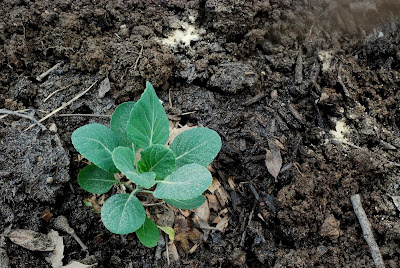
Roodnerf Brussels Sprout.

Of course, one must work in soil supplements most times. For powders, I like using a rake.
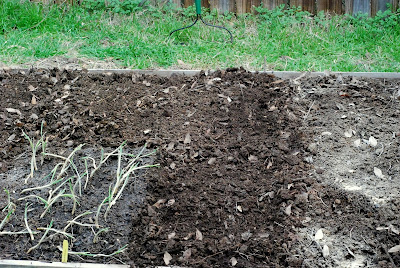
This is my first time using rock phosphate. I’m hoping it helps. My soil tends toward too much nitrogen (user error through trial and error) and alkaline pH. I haven’t found a supplement that added enough of the others to get my little $3 Burpee Soil Test Kit even into the mid-range. Fingers crossed that this does that trick. I picked it up for a reasonable price at The Natural Gardener.

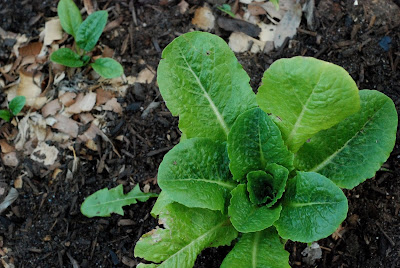
A volunteer romaine from the lawn that I brought into the fold, with some seed sown Bloomsdale Spinach in the background.
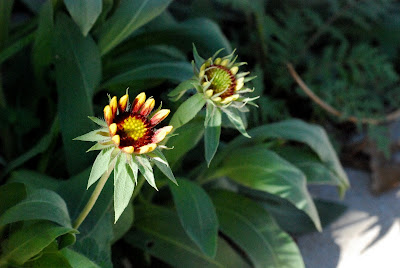
The Blanket Flowers in the rear side patch have been trying with all their might to push a bloom (or two!) to the tops of their stalks. They have succeeded.
And finally, I’ll leave you with a peak at a secret! I cannot wait for it to enlarge into something for dinner!
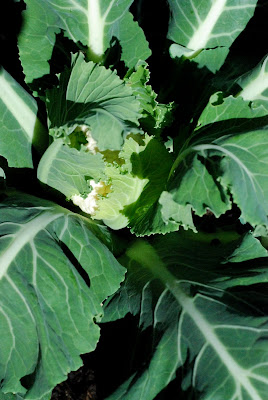
This one’s called Amazing Cauliflower.
Seed Varieties Sown Spring 2012.

This post will be updated throughout the year.

Group

  • Variety Name – Source (if known)

Tomatoes

  • Chadwick Cherry – Self-saved
  • Black Prince – Southern Exposure Seed Exchange
  • Riesentraube – Baker Creek Heirloom Seeds
  • Zapotec Pleated – Seeds of Change (12/10)
  • Oxheart – Self-saved
  • “Mini rainbow assortment” – Saved from Austin, TX Farmer’s Market
  • “Newport Purple Heirloom” – Saved from Newport, OR Farmer’s Market

Onions

  • Violet de Galmi – Baker Creek Heirloom Seeds
  • Australian Brown – Baker Creek Heirloom Seeds

Peppers

  • Yolo Wonder, Sweet Pepper – Maffin Family
  • Ancho/Poblano Chile Pepper – Seeds of Change (sell by 12/10)
  • Jalapeno Chile – Seeds of Change (sell by 12/10)
  • Jalapeno – unknown/gift
  • Czechoslovakian Black Pepper (hot) – Southern Exposure Seed Exchange (10/10)
  • Anaheim Pepper – Baker Creek Heirloom Seeds
  • Long Red Cayenne Pepper – Southern Exposure Seed Exchange (11/10)
  • Chinese Five Color Pepper – Baker Creek Heirloom Seeds
  • Fish Pepper – Baker Creek Heirloom Seeds
  • Purple Beauty Pepper – Baker Creek Heirloom Seeds
  • Emerald Giant Pepper – Baker Creek Heirloom Seeds
Lettuce
  • Chadwick’s Rodan – Baker Creek Heirloom Seeds
  • Rouge Grenobloise – Baker Creek Heirloom Seeds
  • Mignonette Bronze – Baker Creek Heirloom Seeds
  • Little Gem – Baker Creek Heirloom Seeds
  • Gentilina – Baker Creek Heirloom Seeds
  • Cimmaron – Baker Creek Heirloom Seeds
  • Amish Deer Tongue – Baker Creek Heirloom Seeds
Brasica Family
  • Early Purple Sprouting Broccoli – Baker Creek Heirloom Seeds
  • Amazing Cauliflower – Territorial Seed Company
  • Roodnerf Brussels Sprouts – Territorial Seed Company
Greens
  • Even’ Star Land Race Collards – Southern Exposure Seed Exchange
  • Lark’s Tongue Kale – Southern Exposure Seed Exhange
  • Perpetual Swiss Chard – Territorial Seed Company
  • Italian Chard – Unknown/gift
  • Bloomsdale Spinach – Unknown/gift
  • Double Purple Orach – Territorial Seed Company
  • Violetta Pac Choi Hybrid – Territorial Seed Company
Herbs
  • Lemon Basil – Baker Creek Heirloom Seeds
  • Cumin – Baker Creek Heirloom Seeds
  • Dark Green Italian Plain Leaf Parsley – Southern Exposure Seed Exchange
  • Genovese Basil – Unknown/gift
  • Bouquet Dill – Seeds of Change (12/10)
  • Cilantro – Ferry Morse (sell by 2006)
  • Red Rubin Basil – Seeds of Change (12/10)
Others
  • Ground Cherries / Strawberry Husk Tomato – Baker Creek Heirloom Seeds
  • Tomatillo – unknown/gift
  • Golden Amaranth – Southern Exposure Seed Exchange

Flowers

  • Red Cherry Marigolds – Baker Creek Heirloom Seeds
  • Marigold Cracker Jack Mix – Baker Creek Heirloom Seeds


Want to trade? There’s a page for that – Trade Box.

Mmm, poop.

Success!

Today we made the drive to The Natural Gardener on Old Bee Caves. This was our first trip there, and it was actually closer than I’d imagined.

Oh, boy. It was like Disneyland for dirt nerds! They really mind the details and you can tell, around every corner, that the people who put their time in really take pride in what they do. Sure, there’s a Buddha statue for sale, but they’ve staged the statue as though it were forty feet tall – complete with a miniature bamboo fence, finely bladed grass, and pebble path to the base for any 8 inch folks that may wish to pay tribute.

I think I was most excited by the tiny pots full of supplements. I got to touch and smell the different rock bits, mulch chips, soils, and sands. I make do with what the words tell me, but there’s no replacing the feel and the aroma of what goes in the soil.

We picked up some leather gloves to replace those lost to the Chainlink Removal Project. I found the largest floppy garden hat I’d ever seen, and almost got it…until the price tag showed its face. We did find section dedicated entirely to spot watering soaker hoses (and brought home the brochure.) A 5lb bucket of Rock Phosphate and a.receipt for the soil yard and we were off.

Pulling into the lot in front of piles of earthly bits, I eyed each pile. I wanted two. The rest could wait for other folks.

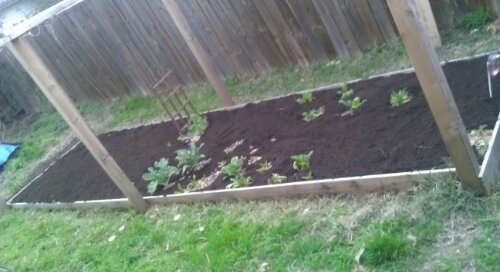
The truck wasn’t quite sure what to think of a cubic yard of well composted farm manure, but it made it just fine. Thirteen wheel barrows full later, and we had a beautiful garden bed with a pile for later.

image

Caring for the wee ones.

When sprouting indoors from seed, quite often the light comes from one direction. My tomato sprouts shall demonstrate:

image

I rotated them last night when they were facing the other way. They’ll get rotated 90 degrees tomorrow.

Nearly all of the tomato sprouts are up now. They usually appear one to three at a time until the ones that are going to germinate at all have done so. The ground cherries have yet to make an appearance.

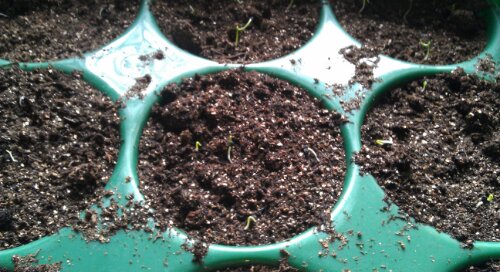
The peppers, absent last night entirely, have almost all risen in unison today. Here are two emerging from their seed casings.

image

The leaves will open more, discarding the seed’s exterior to the soil.

Onions don’t have two seed leaves like many veggies do, and end up hanging onto their seeds for quite awhile.

Onion sprouts start like little wriggly, white, worms.

image

There’s one in the middle there, blending in nonchalantly, and another along the top edge.

The root end takes a few days to take hold, and as it’s working on that, the sprout elongates.

image

With the root end more firmly gripping the earth, the sprout musters its wee strength and starts to stretch for the sun.

image

At this stage, they are kind of comical. Bending this way, twisting around, seed ends getting stuck on other sprouts nearby…they amuse me a fair bit with their antics.

The air is dry here lately. A few weeks without rain, little humidity, and clear nights has the static up and the soil gasping quickly between waterings. I’m watering now by gently pouring small amounts near the sprouts. I don’t want to drown them, or soak the soil, but misting with my spray bottle won’t last 12 hours in these conditions.

I am getting antsy to put the seeds in the garden next weekend. Today was intended as a soil amendment day, but both Plan A and Plan B for adding compost and manure were a bust. Hopefully it comes together tomorrow so I can have it piled and ready as a weekday evening project this week.

Thing I learned today? 

– Beets aren’t something to start inside, but should be direct sown like other root veggies. So sayeth the package.

Any activity in your growth this week? Any prep work to be done or planting you’re (im)patiently waiting to do?

Seed Tray Labeling

When I first started gardening, I wanted row labels. I fell in love with the polished brash signs on sticks. They were out of my price range.

Channeling my inner child, I looked into Popsicle sticks. While researching types, sizes, pricing, and local sources, my mind wandered. Did I have some Popsicle sticks in my craft shoebox? I went to look…nope. What did I have that might work?

Colored toothpicks!

Things I (re)learned (that)day:

  1. Things that are on hand are often better than specially made things that cost money and take up extra space. (I like relearning this in new areas of my life.)
  2. Reusable is important. When I’m done with this tray, I’ll simply brush off the toothpicks and put them back in their (designated garden usage only) jar.
  3. Color is fun, but not necessary.
  4. Save the gardening budget for things that actually grow, or directly feed things that grow, when at all possible.

But wait a minute, you say, how do you remember what’s in each row?

The answer is simple: Magic.

Or a camera phone (or other digital camera, or pen and scratch paper)

It’s important, I’ve found, to do nothing else with my brain in between placing the seeds, laying out the packets, and taking the pictures. I can’t move the tray (I might rotate it and if it’s just rows, or quadrants, I may not remember which way is “up.”) That sort of thing.

If you notice, the toothpick layout does not exactly match the seed packets. That is what happens when you want to make sure you take the picture before going for your nightly walk…and forget to lay the last two seed packets down.

So even though I laid out my rough “grid,” laid out my seed packets to “match,” and took my pictures, I could have still had an “oops surprise” later on trying to remember what those last two spots on the right with the orange toothpick were.

Mystery solved!

Now you may be saying, that picture is small, from a cell phone, I can’t read the fine print – what’d you plant?

Pictured above (left to right, top to bottom as you move left to right):

  • Lark’s Tongue Kale
  • Even’ Star Land Race Collards
  • Dark Green Italian Parsley
  • Lemon Basil
  • Cumin
  • Amish Deer Tongue Lettuce
  • Cimmaron Lettuce
  • Gentilina Lettuce
  • Little Gem Lettuce
  • Mignonette Rouge Lettuce
  • Rodan (Chadwick’s) Lettuce
  • Rouge Grenobloise Lettuce
  • Cracker Jack Mix Marigold
  • Red Cherry Marigold

I liked the romaine I grew last year in flavor, but not in production, and the other varieties of lettuce I grew I didn’t want to eat. That makes this season a Try Again one when it comes to greens. From this myriad of choices, I’m hoping a few stand out as delicious, productive, and happy plants. If I luck into a few such species, they’ll be rewarded in my Fall 2012 garden with more space. Whereas some of the underperformers will have joined other packets in my Trade Box.

Sprouts!

A few days ago, the first little white wriggles of onion life appeared…in half of the tray.

Things I learned:
1) Seed trays with high side edges need to be rotated to allow for even sun exposure.

image

Now is a vital time in the little sprouts’ lives. They don’t yet have a root system to sustain themselves through drier times, so it’s even more important for me to remember to mist them every day than it was before they sprouted. An unsprouted seed may still sprout, but a dead sprout is mere compost.

Last night I was still without any tomato or pepper sprouts. That was ok. It was still early. I almost made it to bed without watering them, though. The heated soil dries out more quickly than the room-temperature onion soil, so I skipped the spray bottle and gently poored water over the surface.

This morning:

image

The odd looking fellow in the corner is an unhappy Donkey Ear offshoot. I need to move him to the succulent pot.

Most exciting about these first tomato sprouts is that they are saved seeds! The ones on the left are from a local farmer’s market, where you can purchase a pint of mixed miniature rainbow tomatoes. The ones near the top of the photo are from a farmer’s market in Newport, Oregon.

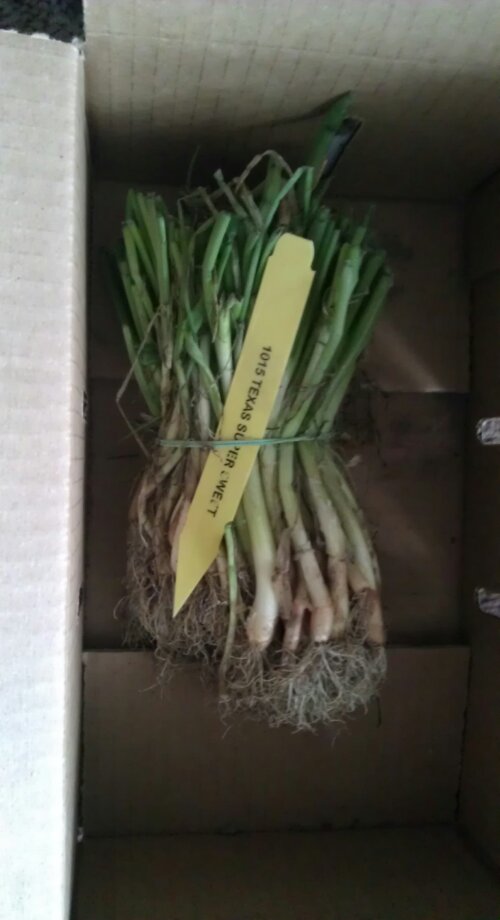
And while there’s all this excitement already, the mailman delivered even more excitement:

image

These will come in handy in two ways.
1) I can plant these in the garden in a few days or a couple of weeks, depending on my taste for risk taking.
2) If my onion sprouts from seed turn to compost again this year, I have these for Plan B.

Ordering starts like this is also handy because I don’t have to plant them right away. They can hang out just like they are for a few weeks, feeding off their little bulb.

Being the cautious adventurer that I am, I’ll put some of these out this weekend, some out in two weeks, and the rest the first weekend of February.

Also this weekend:
– Starting seeds for beets, kale, collards, and other pre-FFD greens.
– Hopefully a road trip east for some cheap organic manure
– Continue addition to garden bed
– Soil testing and amending as needed
– Research soil desires of blackberries, melons, and ground cherries.

What is going on in your neck o’ th’ woods?

Growing from seeds – Tomatoes and Peppers

I try to grow my garden from seeds as much as possible. My first garden (and second, and third…) watched sprouts appear through the glass, but never held the plants in their soil. Why? For one reason or another, it took multiple rounds of trial and error to succeed in getting seeds to sprout, those sprouts to thrive, and those seedlings to harden off properly and make it to harvest outdoors.

Last year, I solved the Great Pepper Secret.
1) Sow seeds indoors weeks before final frost: check.
2) Use seed starter mix*, or your own mix of lighter soil particles: check.
3) Keep seed bed evenly moist**: check.
4) Place in sunny window***: check.

I waited. I misted. I kept it humid. I waited some more. I checked the expected time for germination on the first seed packet, and the second. “First sprouts to appear in 7-10 days.” “Days to germinate: 10-14 days.” I was two weeks in and then some. Nothing. I checked my books. I read forums online. Finally, I reread the seed packets.

And there it was. The missing piece. “Soil temperature for germination: 75-85 degrees F.”

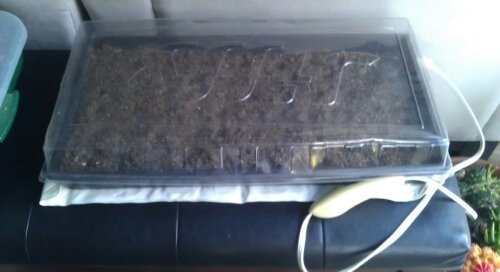
Well, didn’t I feel a fool. It was January. My house was lucky to hit 70 with the heat on. I needed to warm up the seeds without killing the heating bill. Online digging lead me to “seed tray mats.” Funny. Those look like big heating pads. I had a heating pad. Free and less-stuff-friendly!

I remove the fabric sleeve to avoid any stains it may acquire, set it.on.medium, and voila!

image

Due to the added warmth, I mist it at least once a day, and check it twice a day to make sure it’s not too dry.

Last spring was a proud season for me. Each plant in my garden bed was grown from seeds in my entryway. (My lovely Other Half quietly and patiently awaits the day in March when the entryway is Obstacle-Free.)

This year I have some new seeds to try for the first time,
– Melons
– Winter squash
– Ground cherries
– Beets

or for the n-th time (so far without successfully reaching harvest.)
– Onions

Any experience with the above? Any tips to share?

*My first seed attempts involved regular soil. Results were less than exciting.
** My next mistake was to water as often as a houseplants, which is to say, not nearly often enough and with much too much water.
*** Indirect morning sun is not sufficient. Lesson learned 2009.

Slugs!

image

The slugs (or snails as I more often see in my garden) like my Violetta Pac Choi as much as I do, it seems.

My solution?

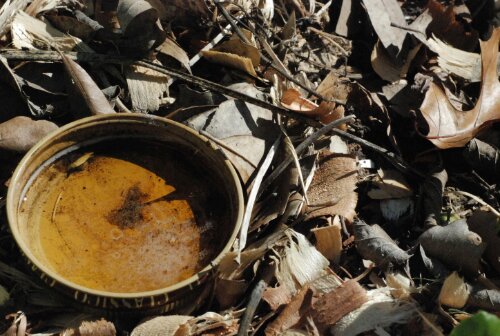
image

An old spaghetti sauce lid full of an IPA some one left at our house. Stouts, wheats, and other Other Half Approved Brews don’t make it to the garden. Thankfully our friends are a diverse crowd and I usually have a misfit beer on hand.

If you’re without unwanted beer, I’ve also had luck with rings of rock salt (sold less expensively at our grocery store when labeled “ice cream salt.”)

Of course, if you’re less squeamish than I, there’s always the seek and squish method.

Onions, Peppers and Tomatoes! (Oh, my!)

It’s seed sowing season here in Central Texas. We’re approximately 10 weeks away from the average final frost date. Approximate, because it depends a fair bit upon one’s location relating to “town bubbles” as well as possible elevation and other microclimate factors. Not to mention the conservative approach versus the riskier approach – which is an entirely personal decision.

I like to start my seedlings indoors when possible, as early as possible. If I start them earlier, and am unlucky with my germination, I may have time to try again. At the least, the local nurseries won’t be sold out forcing me to buy from a big box store if I want plants of that type.

This year, right after planning my garden plot on some graph paper, I re-reminded myself on the date to plant or sow relative to the the Average Final Frost Date here. Risky, or conservative (depending upon to whom you talk) I call the FFD in my neighborhood March 15th. If the 10 day weather forcast is looking lovely on March 8th, I’ll put seeds out early. If it’s sketchy, I’ll hold off.

With my memory refreshed, I started my timeline. March 15th, minus ten weeks, is approximately January 5th. So I’m a week early. The plants will merely be a week bigger.

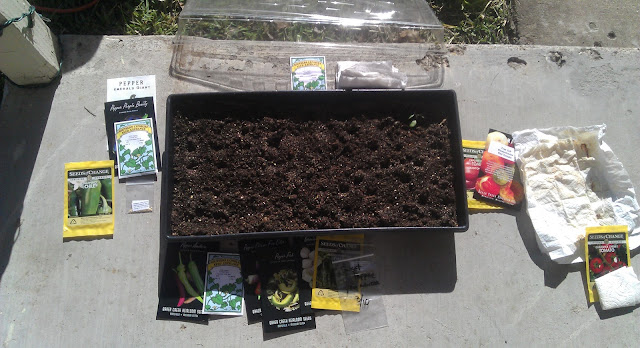
This is a seed tray made from a clearance item at Home Depot. Apparently people store ornament balls in these. I use them as easily measured seed sowing “plots.” It even has a lid for humidity! (Thanks to my mother for finding it and suggesting its use.)

Some folks are talented and resourceful enough to make their own seed starting mix. I have yet to dive into that project. Instead, I keep an eye out for off-season sales. The bag shown had four friends just like it, at the grocery store of all places.

This tray has five seeds per circle laidout as a square with a dot in the middle. Forty Australian Brown Onions and forty Violet de Galmi. I don’t have a historically successful time with onions, so I thought to plant in excess and succeed at least a little that way. Sown on the 28th, I hope to see sprouts next week.

Today’s sowing was peppers, tomatoes, and their relatives.

This is an actual seed tray, same mix. You can just see the indentation of my finger making spots for each seed. I lay the seed packets out in order of sown row. Then after I’m done, I sketch the seed tray with dots representing each seed, and label accordingly. This is how I will tell which seeds germinated well, which seed sources may gain more of my business, and also simply so I don’t end up with a tomato wishing to grow 8 feet tall in a pot where I thought I put a 2 foot variety.

Have you started any seed trays? Do you plan to? Or is it too soon in your area?

Acorns

I had a lazier garden day, today. I found a free manure source on Craigslist whom I need to call. I checked on the lettuce transplants (most appeared happy, a few weaker ones may not recover.) I assembled the latest weed eater, edged both front yard sections, the walk, and whacked around the garden boards.

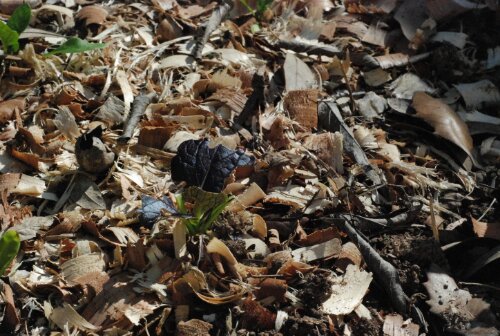
I spent a spell sitting on a crossbeam spanning the turned earth, munching almonds, and watching the soil. Overturning a spot of leaves with a twig revealed an acorn. Setting down my stick, I cracked the acorn. Carefully prying it apart, I could see hundreds of tiny insect eggs.

Uh oh.

I laid both sides egg-side up on my beam in the sunlight. I set about to find more acorns, disturb the eggs, and hopefully reduce spring infestations of detrimental life.

Things I learned today:
1) Acorns do not belong in garden mulch.
2) Weed eaters are an art form to utilize well. I require more practice, for following a concrete drive in a straight manner was never required in my country childhood.